
Percy Bysshe Shelley Profile
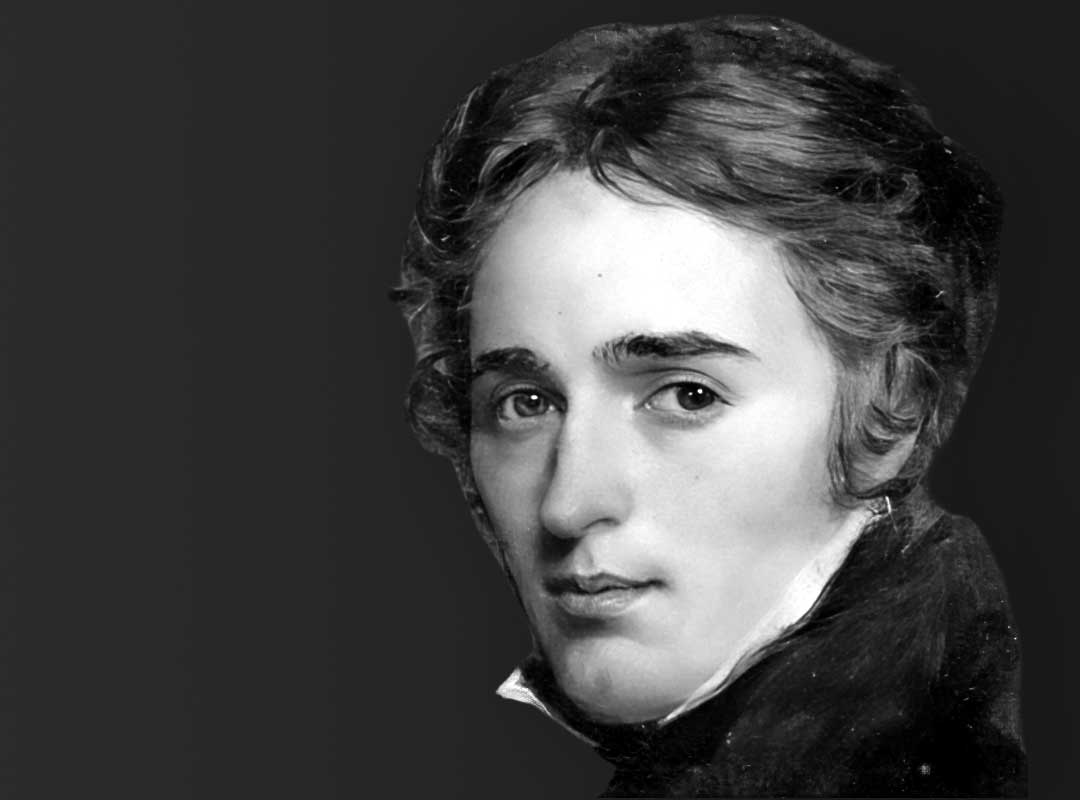
Carolyn and I have long appreciated the work of English poet Percy Bysshe Shelley, who was one of the leading figures of the English Romantic Movement, celebrated for his visionary poetry and radical ideas. He is best known for works such as Prometheus Unbound, Ode to the West Wind, and Adonais — lyrical masterpieces that explore themes of freedom, imagination, and the transformative power of nature and the human spirit. Shelley was also known for his outspoken political idealism and advocacy of nonviolent resistance, which made him a controversial figure in his time. His passionate belief in human perfectibility and artistic expression profoundly influenced later poets and thinkers, establishing him as one of the great voices of Romanticism.
Percy Bysshe Shelley was born in 1792 in Broadbridge Heath, near Horsham, Sussex, England, the eldest son of a wealthy, aristocratic family. Shelley’s father was a baronet and a member of the British Parliament for Horsham, later representing Shoreham. He was a conventional country gentleman with strong political and social ambitions, hoping his son would follow a respectable path. Shelley’s mother came from a wealthy Sussex family and was known for her beauty, refinement, and adherence to traditional values. Together, his parents managed the family’s estate at Field Place and maintained the expectations of upper-class English society — values that Shelley would later rebel against through his radical ideas and unconventional lifestyle.
Shelley’s early childhood was spent at the family estate, Field Place, where he grew up surrounded by nature. As a child, Shelley was imaginative, sensitive, and intensely curious. He spent much of his time exploring the countryside around his family’s estate, lost in daydreams and fascinated by nature’s mysteries. He showed an early passion for reading, especially tales of the supernatural, mythology, and adventure. Shelley was also drawn to scientific experimentation, sometimes alarming his family with small explosions or chemical experiments. Though gentle and affectionate, he often felt misunderstood by his more conventional parents and peers, which fostered an early sense of isolation and a fierce independence that would define his later life and poetry.
In 1798, at the age of six, Shelley was sent to the Syon House Academy near London, where he struggled with bullying and isolation but showed remarkable intellectual ability and imagination. In 1804, he transferred to Eton College, one of England’s most prestigious schools. There, his rebellious spirit became evident — he resisted authority, questioned religious doctrine, and was nicknamed “Mad Shelley” for his eccentric behavior and fascination with science and the occult. During these years, he began writing his first poems and stories, laying the groundwork for his lifelong passion for literature and radical thought.
As Shelley continued his education, he developed his distinctive intellectual and creative character. At Eton College, he endured bullying for his unorthodox views and refusal to conform, but he began writing poetry and fiction. He published his first literary works — Original Poetry by Victor and Cazire (with his sister Elizabeth) and the Gothic novel Zastrozzi — while still a teenager. In 1810, Shelley enrolled at University College, Oxford, where he immersed himself in philosophy, science, and radical political thought. That same year, he published St. Irvyne or, The Rosicrucian, further revealing his fascination with the mystical and the rebellious.
In 1811, while at Oxford, Shelley published The Necessity of Atheism, which led to his expulsion for refusing to renounce its ideas. Soon after, he eloped with 16-year-old Harriet Westbrook, defying his family’s wishes and causing a lasting rift with his father. During these years, he became deeply involved in radical politics and social reform, publishing pamphlets advocating atheism, free love, and equality. Shelley and Westbrook lived in various places across England and Ireland, often in financial difficulty, before their marriage deteriorated, and Harriet died by suicide.
In 1813, while living near London, Shelley once encountered a group of poor Irish beggars and, moved by their suffering, emptied his pockets and gave away nearly all his money. On another occasion, he reportedly invited destitute strangers into his home to share a meal, despite having little himself. These impulsive acts of generosity reflected his deep belief in human equality and his dream of a world free from poverty and oppression — principles that guided both his life and his poetry.
In 1814, Shelley met Mary Godwin, daughter of the philosopher William Godwin and feminist writer Mary Wollstonecraft, and the two travelled to France — an event that marked a turning point in his life and poetic evolution. Shelley’s relationship with Mary was one of profound intellectual and emotional partnership. The two were united by shared ideals of love, freedom, and artistic vision. Their bond endured personal tragedy and exile, with Shelley encouraging and inspiring Mary’s writing.
Shelley and Mary’s close friend Lord Byron entered their lives in 1816, when they all spent a fateful summer together at Villa Diodati on Lake Geneva. Confined indoors by incessant storms, the group — Byron, Shelley, Mary, and Byron’s physician John Polidori — held late-night discussions about science, life, and the supernatural. Byron proposed that each write a ghost story, and from this challenge emerged Mary’s Frankenstein, one of the most enduring works of Romantic and Gothic literature. This was also where Shelley wrote Hymn to Intellectual Beauty.
Later that year, Shelley married Mary. In 1818, the couple moved to Italy, where Shelley composed many of his greatest works, including Prometheus Unbound, Ode to the West Wind, The Cloud, and To a Skylark. These years were also marked by personal tragedy — the deaths of several of his children — and deep philosophical reflection. Despite his struggles, Shelley’s poetry from this period reached new heights of visionary power and lyrical intensity. During this fertile yet tumultuous period, Shelley also turned inward, exploring the depths of his own consciousness and the mysterious forces that shaped his imagination — an inner voyage that would profoundly influence his later spiritual philosophy.
Shelley occasionally used opium, a common practice among writers and intellectuals of his era, primarily to ease the chronic pain and insomnia that plagued him. While there’s no evidence of addiction, opium’s dreamy, hallucinatory effects likely deepened the visionary quality of his poetry and heightened his fascination with altered states of consciousness, death, and transcendence. Combined with his natural imagination and philosophical curiosity, these experiences contributed to the ethereal, otherworldly tone found in works like Alastor and Prometheus Unbound, where the boundaries between dream, spirit, and reality dissolve into pure poetic vision. These explorations of altered states and visionary experience also shaped Shelley’s evolving spiritual outlook, drawing him toward a more expansive and mystical understanding of reality.
Shelley’s spiritual perspective was deeply unconventional and rooted in a belief in a divine, animating force that pervades all of nature rather than a personal or institutionalized God. Though he identified as an atheist in his youth, his later writings reveal a more nuanced pantheism — seeing spirit, love, and beauty as manifestations of a universal intelligence. He rejected dogma and superstition, viewing organized religion as a source of oppression, yet he sought transcendence through imagination, art, and the contemplation of nature’s mystery. For Shelley, the sacred was found not in churches, but in the boundless creative energy of life itself.
During the final year of Shelley’s life, he was living in Italy with Mary and their circle of expatriate friends, including Byron and Edward Trelawny. Shelley completed some of his finest late works, such as The Triumph of Life, which reflected his deepening philosophical vision and growing disillusionment with the world. Shelley and Mary suffered another devastating loss that year with the death of their son William. Then, in 1822, at the age of 29, Shelley tragically drowned in a sudden storm while sailing his schooner off the coast of Livorno. His body was later cremated on the beach near Viareggio, and his ashes were interred in Rome’s Protestant Cemetery — near the grave of his friend John Keats — sealing his place among the immortal poets of the Romantic era.
In 1909, the Keats – Shelley House in Rome opened. This museum is dedicated to John Keats, Percy Bysshe Shelley, and their circle. It houses a rich collection of manuscripts, letters, and first editions of the English Romantic poets, all within the building where Keats spent his final weeks before his death in 1821.
Several films have dramatized the legendary summer of 1816, when Shelley, Mary, Byron, and their companions gathered at Villa Diodati near Lake Geneva — the fateful meeting that inspired Frankenstein. Ken Russell’s 1986 film Gothic portrays the event as a hallucinatory, laudanum-fueled night of horror and imagination, starring Gabriel Byrne as Byron, Julian Sands as Shelley, and Natasha Richardson as Mary. Ivan Passer’s 1988 film Haunted Summer offers a more intimate, atmospheric account, focusing on the group’s philosophical discussions, tangled emotions, and creative inspiration. That same year, Gonzalo Suárez’s film Rowing with the Wind, starring Hugh Grant as Byron, explored the haunting consequences of Mary’s literary creation, blurring the line between fiction and reality. Together, these films capture the mythic power of that stormy summer — the birth of modern horror and a defining moment in Romantic genius.
Shelley’s legacy endures as one of the most brilliant and revolutionary voices of the Romantic era. Though largely unappreciated during his lifetime, his poetry’s lyrical beauty, idealism, and passionate defense of freedom, love, and the imagination profoundly influenced later generations of poets, including Robert Browning, W. B. Yeats, and Dylan Thomas. His works — such as Prometheus Unbound, Ozymandias, and Ode to the West Wind — embody a visionary faith in human potential and the transformative power of art. Beyond literature, Shelley’s radical political and philosophical ideas helped shape modern thought on nonviolence, social justice, and individual liberty, securing his reputation as both a poetic genius and a prophet of human liberation.
Shelley’s words continue to echo across centuries, reminding us of the transformative power of imagination and the eternal dance between beauty, love, and truth. Here are some of Shelley‘s most memorable quotes:
A poet is a nightingale who sits in darkness and sings to cheer its own solitude with sweet sounds.
The sunlight claps the earth, and the moonbeams kiss the sea: what are all these kissings worth, if thou kiss not me?
Soul meets soul on lovers lips.
The more we study, the more we discover our ignorance.
Music, when soft voices die, vibrates in the memory.
Fear not for the future, weep not for the past.
Joy, once lost, is pain.
The pleasure that is in sorrow is sweeter than the pleasure of pleasure itself.
Poetry is a mirror which makes beautiful that which is distorted.
Poets and philosophers are the unacknowledged legislators of the world.