
Lewis Carroll Profile
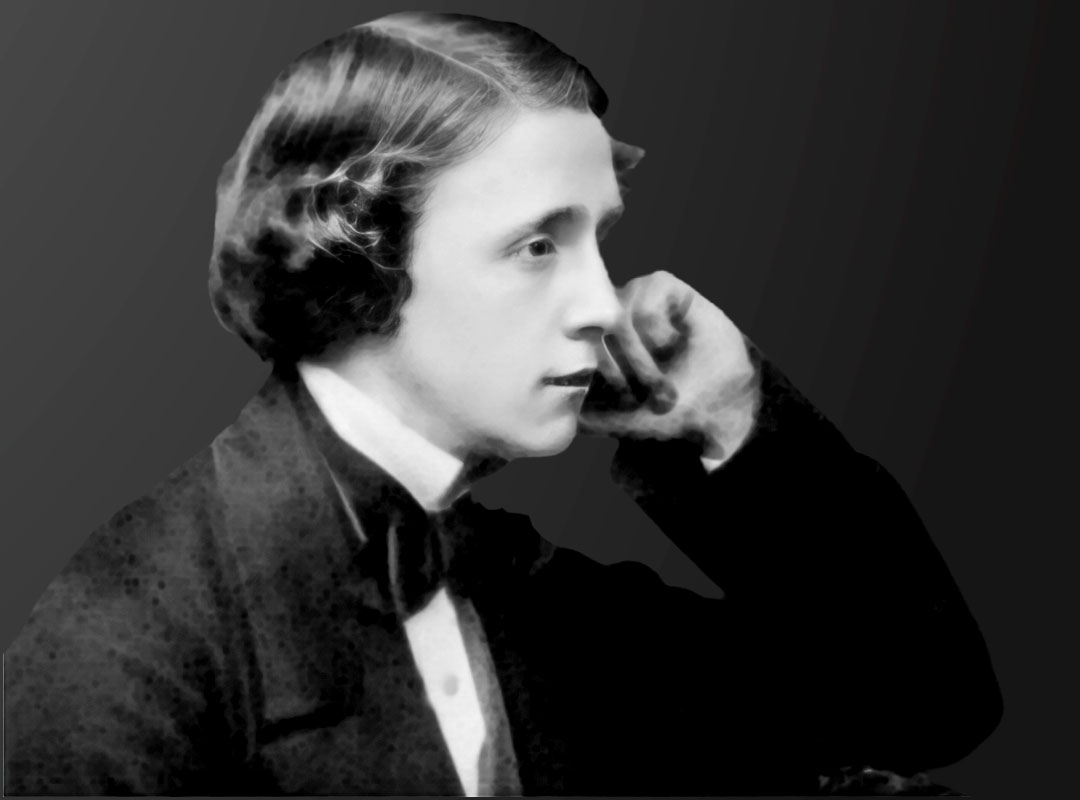
Carolyn and I have long appreciated the work of English author, poet, and mathematician Lewis Carroll, author of Alice’s Adventures in Wonderland and Through the Looking Glass — two of the most influential and imaginative works in children’s literature. Carroll’s playful use of logic, wordplay, and fantasy profoundly shaped modern literature and inspired countless adaptations in art, film, and philosophy. In addition to his literary fame, Carroll contributed to mathematics, particularly in logic and geometry, and was an accomplished early photographer, especially of children and notable figures of his time.
Charles Lutwidge Dodgson (Lewis Carroll) was born in 1832 in Cheshire, England. He was the eldest son and third of eleven children in a devout Anglican family. His father was a respected country parson and scholar who served as a parish priest and later as the Archdeacon of Richmond. He was well educated, having studied at Christ Church, Oxford, and published several theological works and mathematical pamphlets, and he strongly influenced Carroll’s intellectual development. Carroll’s mother was known for her warmth, intelligence, and devotion to her large family. She managed the household and cared for their eleven children, fostering a loving and intellectually stimulating home environment that greatly influenced Carroll’s imagination and moral outlook.
As a child, Lewis Carroll was intelligent, imaginative, and introspective. He showed an early love of reading, mathematics, and wordplay, often entertaining his ten siblings with stories, puppet shows, and homemade magazines. Though bright and creative, he was also shy and sometimes struggled with a stammer, which made him more comfortable expressing himself through writing and art. His keen sense of curiosity and fascination with puzzles and logic were already evident, and close relationships with his many siblings would later inspire his imaginative tales and playful sense of fantasy.
Carroll spent his boyhood at Croft Rectory in North Yorkshire. He was educated at home under his father’s guidance, developing strong skills in mathematics, literature, and classical languages. In 1843, Carroll began attending Richmond Grammar School, where his academic excellence quickly became apparent. These years also deepened his love of storytelling, word games, and creative play with his siblings.
In 1845, Carroll entered Rugby School, one of England’s leading public schools, where he distinguished himself in mathematics and writing, though he was unhappy with the school’s strict atmosphere. After leaving Rugby School in 1850, he prepared for university, and in 1851, he matriculated at Christ Church, Oxford. That same year, his mother died suddenly — an event that deeply affected him and marked one of the first major emotional losses of his life.
In 1854, Carroll earned his Bachelor of Arts from Christ Church, Oxford, with first-class honors in mathematics, and was soon appointed as a lecturer in mathematics at the same college. During this time, he also began publishing humorous poems, essays, and short stories under the pen name “Lewis Carroll.” He began experimenting with photography around 1856, during the early days of the medium, and quickly became one of its notable Victorian practitioners. Carroll was particularly drawn to portraiture, creating carefully composed images of children, friends, and prominent figures such as Alfred, Lord Tennyson and Dante Gabriel Rossetti. Carroll viewed photography as both an art form and a scientific pursuit, applying the same precision and creativity he brought to his writing and mathematics.
Around this time, Carroll met the Liddell family. Henry Liddell had recently become the college dean at Christ Church, Oxford, where Carroll was a mathematics lecturer. Carroll soon befriended the dean’s wife, Lorina, and their children — particularly their daughter Alice, who inspired his most famous stories. Known for his charm and storytelling, Carroll often entertained the Liddell children with imaginative tales and games during afternoon outings and photography sessions.
In 1862, Carroll first told the story that would become Alice’s Adventures in Wonderland during a boating trip on the River Thames with the Liddell sisters — Lorina, Alice, and Edith. To entertain them, Carroll improvised a fantastical story about a curious girl who fell down a rabbit hole into a world of wonder and absurdity. Alice, enchanted by the tale, asked him to write it down, which he later did. This spontaneous moment of storytelling became the seed of one of the most beloved works in literary history. Encouraged by friends to publish it, he expanded the story into a book, which appeared in 1865 with illustrations by John Tenniel. The book’s success brought Carroll international fame and established him as one of the greatest writers of children’s literature.
Alice’s Adventures in Wonderland follows a young girl named Alice who tumbles down a rabbit hole into a fantastical world inhabited by peculiar creatures and ruled by illogical laws. Throughout her journey, she encounters characters like the Cheshire Cat, the Mad Hatter, and the Queen of Hearts, each reflecting playful distortions of logic, language, and authority.
Many readers and scholars have noted that Alice’s Adventures in Wonderland contains imagery reminiscent of altered states of consciousness. The famous scene where Alice eats a mushroom to change her size, along with the story’s shifting perceptions of time, logic, and identity, parallels experiences often associated with psychedelic substances. However, Carroll’s inspiration probably came from dreams, mathematical paradoxes, and his fascination with the workings of the subconscious mind.
During the late 1860s, Carroll balanced his work as a mathematics lecturer at Christ Church, Oxford with his growing literary reputation. He published several mathematical texts, including An Elementary Treatise on Determinants in 1867, while continuing to write stories and poems. In 1869, he also produced Phantasmagoria and Other Poems, and began work on the sequel to Alice’s Adventures in Wonderland.
In 1871, Through the Looking-Glass, and What Alice Found There, the sequel to Alice’s Adventures in Wonderland, was published. Through the Looking-Glass begins with Alice stepping through a mirror into an inverted world structured like a giant chess game. There she meets talking flowers, Tweedledee and Tweedledum, Humpty Dumpty, and the Red and White Queens. Both stories explore themes of identity, imagination, and the fluid boundaries between reality and dream.
By the early 1870s, Carroll was recognized as both a serious scholar and one of the most imaginative storytellers of the Victorian era. In 1879, Carroll published Euclid and His Modern Rivals, a witty defense of traditional geometry that reflected his sharp logical mind and humor. During this period, he also continued his photography but gradually lost interest in it. Carroll remained socially active, forming friendships with artists and writers, and began exploring new literary projects that blended fantasy, logic, and satire.
During this period, Carroll wrote the whimsical nonsense poem The Hunting of the Snark, published in 1876 and gaining enduring popularity. In 1884, he published The Principles of Parliamentary Representation, reflecting his interest in political fairness and logic, and in 1885, he released A Tangled Tale, a collection of mathematical puzzles and stories blending logic with humor. Carroll remained deeply involved in mathematics, religion, and writing, while also maintaining his correspondence with many young friends who inspired his imaginative storytelling.
During the early 1890s, Carroll remained active as both a writer and a mathematician while leading a reclusive life at Christ Church, Oxford. In 1889, he published Sylvie and Bruno, an ambitious blend of fantasy, philosophy, and social satire that reflected his deepening interest in morality and metaphysics. He continued producing mathematical works, including Curiosa Mathematica in 1892, which explored logic and geometry. Although his health began to decline, Carroll maintained an active correspondence and continued refining his literary style.
During the 1890s, Carroll lived quietly in Oxford, focusing on his writing and personal reflections during his later years. He published Sylvie and Bruno Concluded in 1893, completing the philosophical fantasy he had begun earlier, though it received a more modest reception than his “Alice” books. Carroll continued to correspond with friends, pursue his mathematical interests, and enjoy his reputation as a beloved author. As his creative output slowed, Carroll increasingly turned inward, reflecting on the moral and spiritual foundations that had guided both his art and his life.
Carroll’s spiritual perspective was deeply shaped by his Anglican faith, which he inherited from his devout family and maintained throughout his life. Though he often questioned dogma and approached religion with logical rigor, he remained sincerely committed to Christian ethics, prayer, and moral integrity. His writings reflect a fascination with the mysteries of existence, the innocence of childhood, and the interplay between reason and faith. Carroll saw imagination as a divine gift — an avenue through which one could glimpse deeper spiritual truths hidden beneath the surface of ordinary reality.
In the final year of his life, Carroll was in declining health and had largely withdrawn from public life. He continued to correspond with friends and family and occasionally worked on his mathematical interests, but his strength was fading. He spent much of his time at his sisters’ home in Guildford, Surrey. In 1898, Carroll developed influenza that progressed to pneumonia, and he passed away peacefully at the age of 65, leaving behind a lasting legacy as one of the most imaginative and influential writers of the Victorian era.
Alice’s Adventures in Wonderland became closely associated with psychedelic culture in the 1960s because its vivid imagery, dreamlike logic, and scenes of shifting perception resonated with the experiences described by those experimenting with psychedelics. The story’s talking animals, distorted sense of time, and Alice’s size changes after eating a mushroom or drinking mysterious potions mirrored the sensations of altered consciousness. Jefferson Airplane’s 1967 song White Rabbit explicitly linked Carroll’s tale to the psychedelic movement, using references to Alice, the Dormouse, and the Queen of Hearts as metaphors for mind expansion and the countercultural quest for deeper meaning through altered states.
Carroll’s legacy endures as one of the most imaginative and influential figures in English literature. His masterpieces Alice’s Adventures in Wonderland and Through the Looking-Glass revolutionized children’s fiction with their playful logic, linguistic inventiveness, and dreamlike surrealism — works that continue to inspire countless adaptations in art, film, and philosophy. Beyond literature, Carroll’s contributions to mathematics, logic, and early photography reveal the depth of his analytical and creative mind. His unique blend of whimsy and intellect has made him a timeless symbol of curiosity, wonder, and the boundless possibilities of imagination.
Here are some of Lewis Carroll’s most memorable quotes:
It’s no use going back to yesterday, because I was a different person then.
I know who I was when I got up this morning, but I think I must have been changed several times since then
But I don’t want to go among mad people, Alice remarked.
Oh, you can’t help that," said the Cat: we’re all mad here. I’m mad. You’re mad.
How do you know I’m mad?" said Alice.
You must be," said the Cat, "or you wouldn’t have come here.
Alice laughed. There's no use trying, she said. One can't believe impossible things.
I daresay you haven't had much practice,' said the Queen. “When I was your age, I always did it for half-an-hour a day. Why, sometimes I've believed as many as six impossible things before breakfast.
Alice: How long is forever?
White Rabbit: Sometimes, just one second.
One of the deep secrets of life is that all that is really worth the doing is what we do for others.
My dear, here we must run as fast as we can, just to stay in place. And if you wish to go anywhere you must run twice as fast as that.