
Nikola Tesla Profile
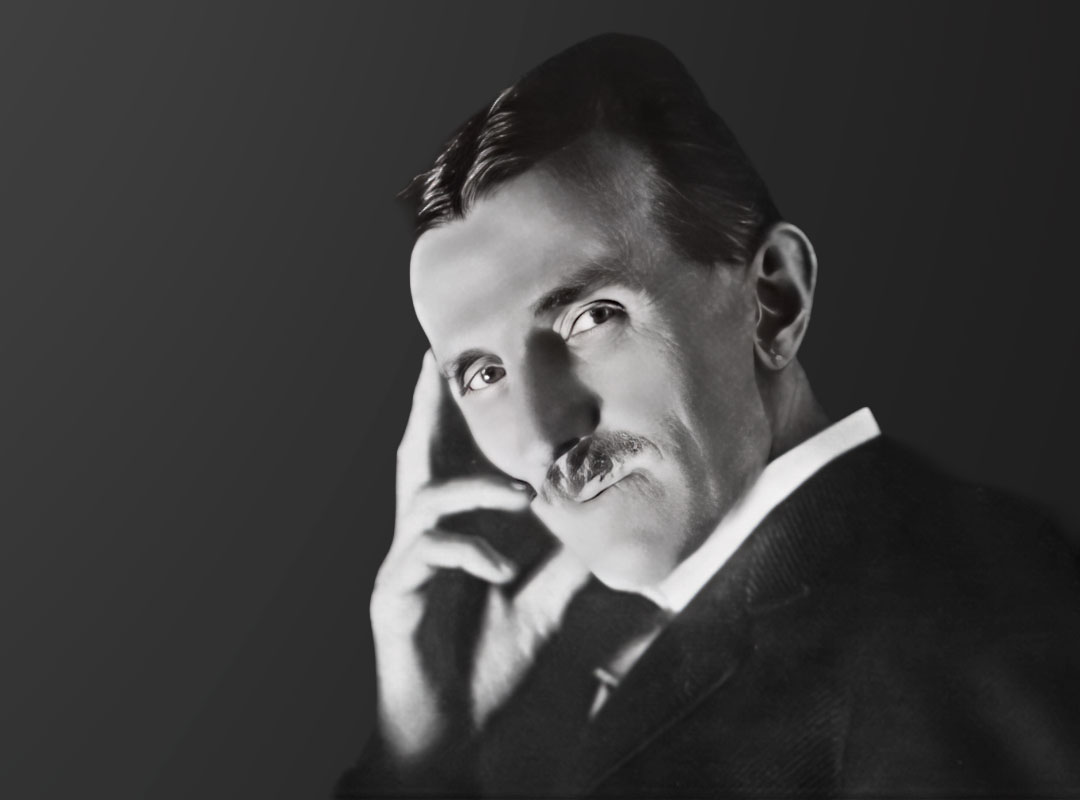
Carolyn and I have appreciated the work of pioneering inventor, electrical engineer, futurist, and visionary mystic Nikola Tesla, who helped shape the modern electrical world by developing the alternating current (AC) system, which became the global standard for power transmission. He invented the induction motor, advanced wireless energy concepts, and created the Tesla Coil, a key device in radio technology. Tesla is most well-known for his role in the War of Currents, where his AC system triumphed over direct current, enabling efficient long-distance electricity distribution. His visionary ideas about wireless communication, robotics, and energy transmission also anticipated many technologies of the modern age.
Nikola Tesla was born in 1856, in the village of Smiljan (then part of the Austrian Empire, now in Croatia), during a dramatic lightning storm — an event later mythologized as symbolic of his future brilliance. He was born into a Serbian family. Tesla’s father was an Eastern Orthodox priest as well as a writer and educator, known for his strong memory and skill with language. His mother managed the household and was remarkably inventive, designing and crafting labor-saving devices and tools despite having no formal education. Together, they created an intellectually rich environment that blended spirituality, creativity, and practical ingenuity — deeply influencing Tesla’s development.
As a child, Tesla was highly imaginative, intensely curious, and intellectually gifted, with a remarkable memory and the ability to perform complex calculations in his head. He experienced vivid mental imagery, often seeing inventions and ideas in detailed visual form before building them — which sometimes felt overwhelming but later became central to his creative process. Tesla was also deeply sensitive and introspective, fascinated by nature and electricity from an early age, and driven by a powerful inner vision that set him apart from other children.
During the 1860s, Tesla began his formal education, first attending primary school in Smiljan and later continuing in nearby Gospić, where his family moved. During these years, he showed exceptional aptitude in mathematics and science, often astonishing teachers with his ability to perform complex calculations mentally. A major turning point came in 1863 when his older brother died in a horseback riding accident, an event that deeply affected Tesla and his family. Despite this tragedy, Tesla continued to excel academically.
From 1870 to 1873, Tesla attended the Higher Real Gymnasium in Karlovac, where he excelled in mathematics and physics and first became deeply fascinated with electricity. During this time, he was introduced to demonstrations of electrical phenomena that profoundly inspired his future work. Shortly after graduating, Tesla returned to Gospić and contracted a severe case of cholera, bringing him close to death; during his recovery, his father promised he could pursue engineering rather than the priesthood. This period marked a decisive turning point, solidifying Tesla’s path toward a career in science and invention.
In 1875, Tesla enrolled at the Austrian Polytechnic in Graz, where he initially excelled and became obsessed with improving electrical machines — especially after encountering a dynamo that sparked his ideas about alternating current. However, he later fell into financial and academic difficulties, left school without graduating, and went through a turbulent period that included gambling and personal struggle. By 1881, Tesla had recovered enough to take a job in Budapest at a telephone exchange, where he made significant improvements to equipment and famously conceived the idea for the rotating magnetic field — laying the foundation for his later AC motor.
During the 1880s, Tesla made some of his most important breakthroughs. In 1882, while working in Budapest and later in Paris for the Continental Edison Company, he conceived and began developing the rotating magnetic field, the key to his induction motor. In 1884, he emigrated to the United States and briefly worked for Thomas Edison before leaving due to disagreements. By 1888, Tesla had built working models of his alternating current (AC) motor and secured major patents, which he licensed to George Westinghouse, marking the beginning of the widespread adoption of AC power and Tesla’s rise to prominence.
Behind these revolutionary inventions lay a profoundly intuitive inner life, as Tesla increasingly came to see his discoveries not merely as mechanical innovations, but as glimpses into a deeper, hidden order of the universe. Tesla held a deeply philosophical and quasi-spiritual view of the universe, seeing it as an interconnected field of energy governed by underlying laws that science could gradually reveal. He often spoke of intuition and imagination as gateways to discovery, suggesting that great ideas come from a higher, almost cosmic source rather than purely rational thought. While not religious in a traditional sense, Tesla expressed a sense of awe toward the harmony and intelligence of nature, viewing humanity as part of a vast, energetic continuum that he sought to understand and harness.
This inner dimension of his life deepened over time. Tesla had a complex relationship with mysticism, blending rigorous scientific thinking with deeply intuitive, almost visionary modes of perception. He frequently described experiencing sudden flashes of insight in which entire inventions appeared fully formed in his mind, what he called “mental pictures”, allowing him to design and test devices entirely in his imagination before building them.
Tesla also reported heightened sensory experiences and powerful inner visions from childhood onward, which sometimes overwhelmed him but ultimately became central to his creative process. While he did not frame these experiences in overtly mystical or religious terms, his language often suggested a sense of tapping into a deeper, universal source of knowledge — what he sometimes described as an underlying field of energy or intelligence permeating the cosmos. These visionary states profoundly shaped both his inventive method and his worldview, positioning him at the intersection of science, intuition, and what many would interpret as a form of secular mysticism.
During the early 1890s, Tesla entered one of the most productive and dramatic periods of his career. He developed high-frequency electrical systems and the Tesla Coil, enabling groundbreaking experiments with wireless transmission, radio waves, and X-rays. Tesla also played a central role in demonstrating the power of alternating current at the 1893 Chicago World’s Fair and in the early stages of harnessing Niagara Falls for hydroelectric power. This period ended tragically in 1895 when a fire destroyed his New York laboratory, along with many of his instruments, notes, and prototypes. In a single night, Tesla lost years of research, equipment, and prototypes — much of his life’s work up to that point. However, rather than giving up, he treated the disaster as a challenge and quickly rebuilt, going on to make further groundbreaking discoveries soon afterward, demonstrating his resilience and unwavering dedication to invention.
During the late 1890s, Tesla reached both a peak of influence and the beginning of major challenges. In 1896, his alternating current system was successfully implemented at Niagara Falls, proving the practicality of long-distance electrical power transmission. He continued pioneering work in wireless communication and power, including large-scale experiments in Colorado Springs between 1899 and 1900. Around 1901, Tesla began constructing the Wardenclyffe Tower on Long Island with backing from J. P. Morgan, aiming to create a global wireless communication and energy transmission system.
During the first decade of 1900, Tesla struggled to realize his ambitious vision of wireless global communication and power. Construction of the Wardenclyffe Tower stalled in 1902 as funding from J. P. Morgan and other investors dried up, eventually leading to the project’s abandonment. During this period, Tesla continued experimenting and proposing new inventions, but faced increasing financial difficulties and diminishing support, while competitors like Guglielmo Marconi gained recognition for radio technology.
Tesla never fully profited from many of his groundbreaking inventions, often selling or relinquishing his patents for far less than their eventual worth, most famously giving up lucrative AC royalties to support George Westinghouse. Meanwhile, others capitalized on, or received credit for, ideas he had pioneered, such as radio technology later associated with Marconi, leaving Tesla under-recognized and financially strained despite his profound impact on the modern world.
Tesla continued to pursue new inventions but faced growing financial hardship and declining recognition. He developed and promoted his bladeless turbine, though it failed to achieve commercial success. During this period, Tesla lived in New York hotels, relying on diminishing resources, while his earlier projects, especially Wardenclyffe, remained unrealized. By 1916, he was also dealing with mounting debts and even bankruptcy proceedings, marking a difficult chapter in his later life despite his enduring visionary ideas.
In 1917, Tesla was awarded the prestigious Edison Medal for his contributions to electrical engineering, even as his long-abandoned Wardenclyffe Tower was demolished that same year. Tesla continued living in New York hotels under increasingly strained financial conditions, becoming more reclusive and eccentric. He remained devoted to his ideas and routines, famously caring for pigeons, while his public prominence continued to fade despite the lasting impact of his earlier achievements.
By the late 1920s, Tesla lived a largely quiet and increasingly isolated life in New York, moving between hotels while facing ongoing financial difficulties. Although no major inventions from this period achieved practical success, he continued to propose bold, futuristic ideas, such as wireless power transmission and advanced energy systems, often announced through interviews. Tesla’s reputation during these years shifted toward that of a brilliant but eccentric visionary, as public attention focused more on his past achievements than on his current work.
During the 1930s, Tesla experienced a late resurgence of public attention alongside continued personal decline. In 1931, he was featured on the cover of Time magazine for his 75th birthday, reflecting renewed recognition of his earlier achievements. During these years, he made bold public claims about futuristic inventions, including a “death ray” defense weapon, though these were never realized. Living reclusively in the Hotel New Yorker, Tesla devoted much of his time to feeding pigeons and maintaining his routines, while his health and financial situation continued to deteriorate.
Tesla lived in increasing isolation, although he continued to grant occasional interviews and promote visionary ideas, including his proposed “teleforce” defense system. Though largely removed from active scientific work, he remained mentally engaged and reflective about his past achievements. Tesla’s health declined, and he became more reclusive, sustained in part by a small stipend arranged through intermediaries connected to his earlier supporters.
In the final year of his life, Tesla lived in near-complete isolation at the Hotel New Yorker, physically weakened but still mentally active. He continued to reflect on his life’s work and occasionally spoke with reporters about his inventions and ideas. In 1943, Tesla died alone in his hotel room at the age of 86. Shortly after his death, the U.S. government seized many of his papers for review, adding a final layer of mystery and intrigue to his legacy.
Tesla’s legacy is that of a visionary genius who helped build the foundation of the modern electrical world, especially through his development of alternating current (AC) power systems that still power the globe today. He is remembered not only for his practical inventions, such as the induction motor and Tesla Coil, but also for his bold, forward-thinking ideas about wireless communication, robotics, and global energy transmission.
Though underappreciated in his later years, Tesla has since become an iconic figure symbolizing innovation, imagination, and the power of unconventional thinking. Entrepreneur Elon Musk embraced Tesla’s name for his electric car company — Tesla, Inc., to honor Tesla’s pioneering work in electricity, and to symbolize the company’s mission to advance electric power and transform the future of energy and transportation.
Here are some memorable quotes by Nikola Tesla:
If you want to find the secrets of the universe, think in terms of energy, frequency, and vibration.
I don't care that they stole my idea . . . I care that they don't have any of their own.
Of all things, I liked books best.
The day science begins to study non-physical phenomena, it will make more progress in one decade than in all the previous centuries of its existence. Be alone, that is the secret of invention; be alone, that is when ideas are born.
The scientists of today think deeply instead of clearly. One must be sane to think clearly, but one can think deeply and be quite insane.
My brain is only a receiver; in the Universe there is a core from which we obtain knowledge, strength, and inspiration. I have not penetrated into the secrets of this core, but I know that it exists.
What one man calls God, another calls the laws of physics. . . The gift of mental power comes from God, Divine Being, and if we concentrate our minds on that truth, we become in tune with this great power.