
Alfred Russel Wallace Profile
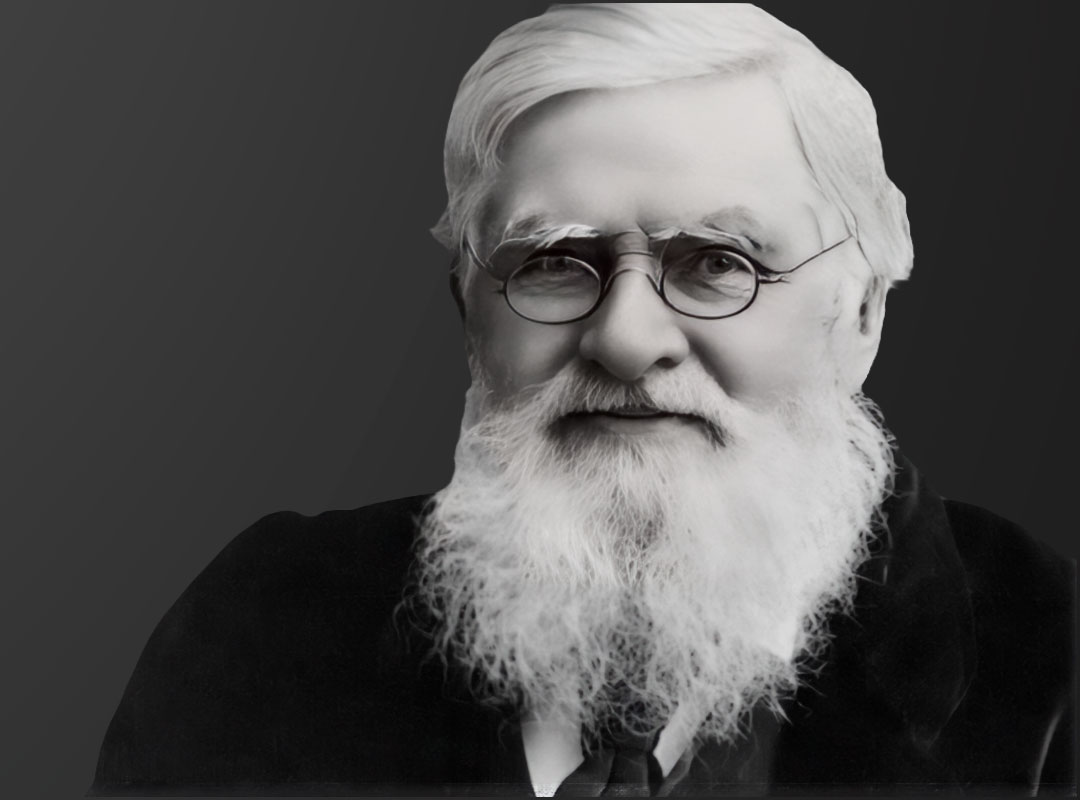
Carolyn and I have appreciated the work of pioneering British naturalist and explorer Alfred Russel Wallace, who is best known for independently conceiving the theory of evolution by natural selection, during a profound visionary experience that he had in Indonesia, which he shared with Charles Darwin in 1858.
Wallace’s extensive fieldwork in the Amazon and the Malay Archipelago (between the Pacific and Indian Oceans) led to major contributions in biogeography, including identifying what became known as the Wallace Line, a boundary separating Asian and Australian animal species.
Wallace wrote influential books such as The Malay Archipelago and was an early thinker on topics ranging from ecology to the possibility of life beyond Earth. Wallace was also a committed spiritualist, believing consciousness, especially the human mind, could not be fully explained by material processes or natural selection alone.
Alfred Russel Wallace was born in 1823, in Llanbadoc, Wales. His parents came from modest but respectable backgrounds, though their fortunes declined over time. His father had trained in law but never practiced; instead, he lived off a small inherited income that gradually dwindled. His mother was the daughter of a middle-class family and managed the household, helping raise their large family of children as finances became increasingly strained.
Wallace was an observant, curious, and intellectually inclined child, though not especially distinguished in formal schooling early on. Growing up with limited financial resources, he developed independence and a practical mindset, often learning through direct experience rather than strict academic training. From a young age, he showed a fascination with the natural world — an interest that would later blossom into his lifelong passion for exploration, collecting, and studying plants and animals.
Wallace’s early environment was shaped by rural landscapes, and in around 1828, when he was about five, his family moved to Hertford, England. Wallace spent his early school years in Hertford, receiving a basic education at local grammar schools. During this period, his family’s financial situation continued to decline, limiting his formal schooling. By around age 14, he left school and was apprenticed to his older brother William as a land surveyor, marking the beginning of his practical training and exposure to the natural landscapes that would later shape his scientific interests.
During the mid-1830s, Wallace worked as a land surveyor alongside his brother across the English and Welsh countryside, gaining extensive firsthand exposure to nature. When surveying work declined in the late 1830s, he turned to teaching in Leicester, England, where he encountered progressive scientific ideas and developed a serious interest in natural history. During this period, he also became an avid reader, studying works on evolution and science that began shaping his early theoretical thinking.
In 1845, Wallace’s brother died, and he faced both hardship and transformation. He struggled financially and turned more seriously toward natural history, forming a pivotal friendship with English naturalist Henry Walter Bates. In 1848, the two set off for the Amazon Basin to collect specimens and study wildlife, launching Wallace’s career as an explorer. In 1852, when he was returning to England after years of collecting specimens in the Amazon, his ship caught fire and sank in the middle of the Atlantic, forcing him and the crew to abandon it and drift for days in a small lifeboat. Nearly all of his carefully gathered specimens and notes were destroyed in the disaster — a dramatic early setback in his scientific journey, yet he survived an event that, despite its devastation, did not deter him from continuing his scientific explorations.
After recovering in England, Wallace soon embarked on a new and even more significant journey in 1854 to the Malay Archipelago — the world's largest cluster of over 25,000 islands and islets, located between mainland Southeast Asia and Australia in the Indian and Pacific Oceans, where he began the extensive fieldwork that would lead to his groundbreaking insights into species distribution and evolution.
In 1858, Wallace had a powerful, transformative visionary experience on the island of Ternate (a volcanic island in Indonesia's North Maluku province), when he was suffering from a severe malarial fever. During his feverish, somewhat delirious altered state from the illness, he had a sudden, vivid insight into how species evolve through natural selection — the idea crystallizing in his mind almost fully formed. He quickly wrote up the insight and sent it to Charles Darwin, leading to their joint announcement of the theory.
Most people associate evolution by natural selection with Darwin because he published On the Origin of Species in 1859, a comprehensive and highly influential book that clearly articulated and defended the theory, reaching a wide audience and shaping scientific thought for generations. In contrast, Wallace, who independently conceived the same idea, published less extensively on the topic and did not produce a single landmark volume of comparable impact at that critical moment.
Additionally, Darwin was deeply embedded in Britain’s scientific elite and had decades to refine and promote his ideas, whereas Wallace worked largely in the field and often outside established networks. Wallace himself also graciously credited Darwin as the primary figure, which, combined with historical momentum and education systems, led to Darwin becoming the dominant name associated with the theory while Wallace’s role remained less widely recognized.
Wallace collected thousands of specimens in the Malay Archipelago, while refining his ideas about evolution. He continued his explorations for a total of eight years, gathering evidence that would later underpin his major scientific contributions to biogeography, the study of the geographic distribution of species, and evolution.
In 1862, Wallace returned to England and established himself as a leading scientific thinker. He published numerous important papers, refined his ideas on biogeography — including what became known as the Wallace Line, a boundary separating Asian and Australian species. In 1869, Wallace released his influential book The Malay Archipelago, which brought him wide recognition. During this period, he also began expressing views that diverged from Darwin, particularly regarding human evolution and the role of higher mental faculties.
Wallace became increasingly prominent as a public intellectual, publishing influential works such as Contributions to the Theory of Natural Selection in 1870. During this period, he also openly embraced spiritualism, arguing that human consciousness could not be fully explained by natural selection — bringing him into respectful but notable disagreement with Darwin.
Wallace had a lifelong and deeply committed relationship with spiritualism. Beginning in the 1860s, he became convinced — through attending séances and examining reported phenomena — that communication with non-physical intelligences was real. Unlike many contemporaries, he openly defended spiritualism in his writings, arguing that it provided evidence that consciousness could exist beyond the physical body. This stance set him apart from figures like Darwin and made him both a controversial and uniquely wide-ranging thinker within the scientific community.
Wallace held a deeply unconventional spiritual perspective for a scientist of his time. He became a committed advocate of spiritualism, believing that consciousness — and especially the human mind could not be fully explained by material processes or natural selection alone. While he accepted evolution for the physical body, he argued that higher mental faculties, moral awareness, and spiritual experiences pointed to a guiding, non-material intelligence or purpose in the universe.
At the same time, he continued to write on evolution, biogeography, and natural history. In 1878, Wallace published Tropical Nature and Other Essays, further developing his ideas on evolution, environment, and the distribution of life. He also became an active public lecturer, gaining international attention during a major lecture tour of North America from 1886 to 1887. Throughout these years, Wallace continued to advocate for spiritualism and social reform, expanding his influence beyond science into broader philosophical and societal debates.
Between 1886–1887, Wallace undertook a major lecture tour across North America, where he spoke on evolution, biogeography, and social issues, gaining wide public recognition. In 1889, he published “Darwinism,” a major defense and expansion of the theory of natural selection that clarified and strengthened ideas first shared with Darwin. During this period, he also became more outspoken on political and social reforms, including land nationalization and critiques of economic inequality, further expanding his influence beyond science.
During the 1890s, Wallace became increasingly active in social and political debates. He published works such as The Wonderful Century in 1898, reflecting on scientific progress and its societal impacts, while also advocating for causes like land nationalization and criticizing economic inequality. During this period, he was a vocal opponent of compulsory vaccination policies, engaging in public controversy, and continued to defend his views on spiritualism alongside his scientific legacy.
Wallace remained an active and influential thinker in his later years, and he published major works such as Man’s Place in the Universe in 1903, where he explored humanity’s uniqueness and the possibility of life elsewhere in the universe. Wallace was skeptical about extraterrestrial life, arguing that Earth might be uniquely suited for life and that intelligent beings elsewhere in the universe were likely extremely rare or even nonexistent.
What’s interesting, though, is why he took that stance. In Man’s Place in the Universe, he wasn’t dismissing the possibility out of narrowness, but arguing that the precise conditions required for intelligent life — especially life capable of moral and spiritual awareness might be extraordinarily rare. In a way, he was elevating consciousness to something cosmically special rather than commonplace.
Wallace continued writing on evolution, social reform, and spiritualism, maintaining a strong public presence as both a scientist and a controversial, wide-ranging intellectual. He remained intellectually active into his eighties, continuing to write and reflect on science, society, and spirituality. He published works such as My Life in 1905, which was widely read during this period, and The World of Life in 1910, in which he explored evolution, purpose, and the nature of living systems. Despite his age, he maintained a public presence as a respected elder thinker, synthesizing his lifelong ideas on natural selection, human consciousness, and the broader meaning of evolution.
In his final year, Wallace lived quietly at his home in Broadstone, remaining mentally active though physically frail. He continued corresponding and reflecting on his lifelong interests in evolution, society, and spiritual questions. Wallace died in 1913, at the age of 90, and was widely honored as one of the great scientific thinkers of the 19th century, best known for co-discovering natural selection.
Taken together, Wallace’s life reveals a rare synthesis of empirical rigor and philosophical daring. Wallace’s legacy rests on his independent discovery of evolution by natural selection alongside Darwin, as well as his foundational contributions to biogeography — especially the identification of the Wallace Line. He helped shape modern evolutionary thinking through his extensive fieldwork and writings.
Beyond biology, Wallace remains notable for his willingness to explore controversial ideas, such as spiritualism and social reform, making him a uniquely wide-ranging and original thinker whose influence extends across science, philosophy, and environmental thought. In recent years, Wallace’s contributions have gained broader recognition through renewed historical scholarship, biographies, and public interest that highlight his co-discovery of evolution by natural selection.
Here are some memorable quotes by Alfred Russel Wallace:
I believe all this to be the guidance of a being superior to us in power and intelligence.
Truth is born into this world only with pangs and tribulations, and every fresh truth is received unwillingly.
It seems sad, that on the one hand such exquisite creatures should live out their lives and exhibit their charms only in these wild inhospitable regions...while on the other hand, should civilized man ever reach these distant lands... we may be sure that he will so disturb the nicely-balance relations of organic and inorganic nature as to cause the disappearance, and finally the extinction, of these very beings whose wonderful structure and beauty he alone is fitted to appreciate and enjoy. This consideration must surely tell us that all living things were not made for man.
There is… no contradiction in believing that mind is… the cause of matter.
Mortality is the means by which a permanent individuality is given to spirit.
I slept very comfortably with half a dozen smoke-dried human skulls suspended over my head
There is no escape… either all matter is conscious, or consciousness is something distinct from matter.