
George Orwell Profile
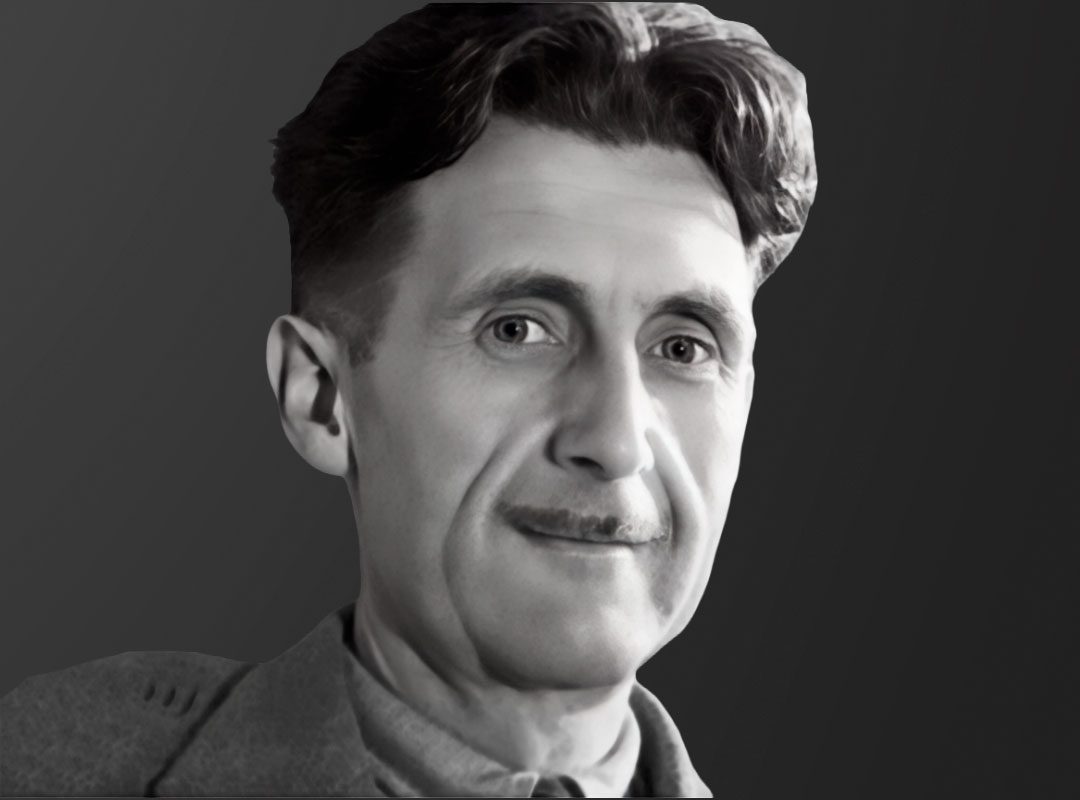
Carolyn and I have appreciated the work of English novelist, poet, and journalist George Orwell, who was one of the most influential English writers and political thinkers of the 20th century, celebrated for his lucid prose, fierce opposition to Totalitarianism, and defense of intellectual freedom and social justice. He is best known for the dystopian novel Nineteen Eighty-Four, which introduced enduring concepts such as Big Brother, thoughtcrime, and doublethink, and for the political allegory Animal Farm, a devastating satire of Stalinism and the corruption of revolutionary ideals.
Orwell was also an important essayist and journalist whose firsthand experiences of poverty, imperialism, and the Spanish Civil War shaped works such as Down and Out in Paris and London, The Road to Wigan Pier, and Homage to Catalonia; his lasting achievement was giving modern culture a remarkably powerful vocabulary for recognizing propaganda, authoritarianism, and the manipulation of truth.
George Orwell was born Eric Arthur Blair in 1903, in Motihari, Bengal, British India. His father was a British colonial civil servant in India who worked for the Opium Department of the Indian Civil Service, overseeing aspects of the government-controlled production and trade of opium. Orwell’s mother was born into a British-French family in Burma, who primarily managed the household and raised him and his older sister. Orwell later described his family’s social position memorably as the “lower-upper-middle class” — respectable and socially privileged, but without much money.
In 1904, when Orwell was about a year old, his mother took him and his sister to England, while his father remained working in India; they settled at Henley-on-Thames in Oxfordshire, where Orwell spent most of his early childhood. These formative years placed him between the world of the British Empire into which he had been born and the relatively modest English middle-class environment that would later become important to his understanding of class and imperialism.
As a child, Orwell was quiet, solitary, imaginative, and intellectually precocious, with an early fascination for books and storytelling. He later recalled inventing stories and imaginary conversations from a very young age and deciding at about five or six that he wanted to become a writer. He was also sensitive to social class, loneliness, and feelings of being an outsider, experiences that became especially pronounced during his school years and later helped shape his sympathy for people living at society’s margins.
Orwell attended a small Anglican convent school in Henley-on-Thames, where he began his formal education alongside his sister. In 1911, at age eight, Orwell was sent as a boarding student to St Cyprian’s School in Eastbourne, an experience that exposed him sharply to class distinctions and that he later portrayed very critically in his autobiographical essay Such, Such Were the Joys. During these years he showed considerable academic promise and developed his literary interests, while his father’s retirement from colonial service in 1912 reunited the family in England. By 1915, Orwell was also writing poetry — with a poem published in a local newspaper.
As a teenager, Orwell developed rapidly as a student and aspiring writer. After winning scholarships, he attended Wellington College briefly in 1917 and then Eton College from 1917 to 1921, where his French teacher was acclaimed novelist Aldous Huxley. Although an uneven student, Orwell read widely, wrote for school publications, and strengthened his literary ambitions. Rather than attend university, he followed his father into imperial service, passing the entrance examinations for the Indian Imperial Police in 1922. Later that year, at age nineteen, he sailed for Burma, beginning the colonial experience that would profoundly shape his opposition to imperialism.
During the 1920s, Orwell served in the Indian Imperial Police in Burma, holding posts in several locations and witnessing British colonial rule firsthand — an experience that increasingly troubled him. While home on leave in England in 1927, he resigned from the police and resolved to become a writer, later drawing on his Burmese experiences in Burmese Days, A Hanging, and other works. From 1928 to 1929, he lived among poorer communities in Paris and London, deliberately experiencing life on society’s margins, living and working among the impoverished and working-class. Orwell worked at menial jobs, such as a dishwasher in Parisian hotels, gathering material that eventually became Down and Out in Paris and London. These years marked his transformation from colonial policeman Eric Blair into the writer who would soon call himself George Orwell.
This journey from imperial authority to life among the marginalized also helped forge the fiercely independent moral philosophy that would become central to Orwell’s life and work. As a secular humanist, Orwell was not conventionally religious and was generally skeptical of organized religion, although he retained a strong moral seriousness that sometimes had an almost spiritual quality. He possessed a deep, complex fascination with Christian morality, ritual, and the spiritual vacuum left by the decline of traditional faith. He valued many ethical ideals associated with Christianity, particularly compassion, humility, sacrifice, human dignity, and concern for the poor and oppressed. His deepest moral commitments centered on truth, individual conscience, freedom, and what he called “common decency,” and he worried that political ideologies such as Nationalism and Totalitarianism could become dangerous substitutes for religious faith in a secular age.
During the early 1930s, Orwell established himself as a serious writer, while teaching and working in a bookshop. In 1933, he adopted the pen name George Orwell with the publication of Down and Out in Paris and London, followed by the novel Burmese Days in 1934 and other early fiction. In 1936, Orwell traveled through the industrial north of England to investigate working-class poverty and unemployment, experiences that became The Road to Wigan Pier in 1937, and helped deepen his commitment to Democratic Socialism. That same year he married Eileen O’Shaughnessy and, at the end of 1936, left for Spain to witness the Civil War.
During the late 1930s and early 1940s, Orwell’s experiences of war and Totalitarian Politics profoundly shaped the ideas for which he became famous. Fighting with the militia in the Spanish Civil War, he was wounded in 1937. At dawn on the front near Huesca, a sniper’s bullet struck him through the throat. Orwell later recalled that his first thought was that he had been hit, followed by the strange sensation of being violently shocked without pain. The bullet narrowly missed major arteries and his spine, temporarily leaving him unable to speak, and he later joked with characteristic understatement that he had always wanted to know what being shot felt like — and now he knew.
Orwell later fled Spain with his wife; these experiences inspired Homage to Catalonia in 1938, and intensified his opposition to both Fascism and Stalinism. After spending some time in Morocco for his health, Orwell returned to England and, during World War II, worked for the BBC’s Eastern Service from 1941 to 1943, producing broadcasts intended for audiences in India and Southeast Asia. By 1943 he had left the BBC and become literary editor of the socialist newspaper Tribune, while developing the political ideas about propaganda, censorship, and the corruption of language that would culminate in Animal Farm and Nineteen Eighty-Four.
During the late 1940s, Orwell produced the two masterpieces that secured his lasting reputation while enduring profound personal loss and worsening health. In 1944, he and Eileen adopted their son Richard, but Eileen died unexpectedly during surgery in 1945; that same year Animal Farm was published, becoming an international success and bringing Orwell widespread recognition. Increasingly ill with tuberculosis, Orwell spent substantial periods on the remote Scottish island of Jura, where he completed Nineteen Eighty-Four, which was published in 1949 to immediate acclaim and controversy. In 1949, while seriously ill and hospitalized, he married Sonia Brownell.
After Orwell published Nineteen Eighty-Four in 1949, he sent his former French teacher at Eton College, Aldous Huxley, a copy, and Huxley replied with a famous letter praising the novel while suggesting that future dictators might ultimately find pleasure, conditioning, and psychological manipulation more effective than terror. Their two most well-known novels therefore offer complementary dystopian warnings.
In Nineteen Eighty-Four, society is controlled primarily through surveillance, censorship, propaganda, fear, torture, and the deliberate destruction of objective truth; in Huxley’s Brave New World, which was published in 1932, people are controlled through pleasure, consumerism, entertainment, genetic and psychological conditioning, and the drug soma.
Orwell feared a world in which authorities deprive people of truth and freedom, while Huxley feared one in which people might become so distracted, comfortable, and conditioned that they voluntarily surrender them — two visions that remain strikingly relevant today. (Perhaps if Orwell had sampled some of the ‘moksha-medicine’ imagined in Huxley’s later utopian novel Island, we might have eventually seen a revisiting of Nineteen Eighty-Four — one in which a truth-revealing, propaganda-dissolving medicine opened the door to a more utopian vision of humanity’s future.)
During the final year of his life, Orwell was gravely ill with tuberculosis and spent most of his remaining time in University College Hospital in London. Having married Brownell only a few months earlier, and having recently achieved enormous international recognition with Nineteen Eighty-Four, he made plans for further writing and hoped to recover sufficiently to travel to Switzerland for treatment. However, his health further deteriorated, and in 1950, at the age of 46, Orwell died after a pulmonary artery ruptured. He was buried in the churchyard of All Saints’ Church in Sutton Courtenay, Oxfordshire, under his birth name, Eric Arthur Blair.
Orwell’s legacy rests on his extraordinary ability to expose the dangers of Totalitarianism, propaganda, censorship, political dishonesty, and the manipulation of language and truth. Animal Farm and Nineteen Eighty-Four became enduring classics, while concepts such as Big Brother, thoughtcrime, doublethink, and the memory hole entered everyday language; “Orwellian” itself became a term for oppressive surveillance and the distortion of reality by those in power. Beyond his novels, Orwell’s essays and journalism established him as a powerful advocate for intellectual freedom, clear language, democratic socialism, and the individual’s right to question authority, making his work remarkably relevant to successive generations.
Orwell’s work remains especially important today because he understood how surveillance, propaganda, censorship, political polarization, and the manipulation of language can gradually reshape people’s perception of reality. In an age of social media, artificial intelligence, misinformation, sophisticated digital surveillance, and competing claims about what constitutes truth, his warnings about “doublethink,” manufactured enemies, historical revision, and the power to control information can feel strikingly contemporary. Perhaps Orwell’s most enduring lesson is that freedom depends not merely on resisting overt tyranny, but on protecting our ability to think independently, speak clearly, question authority, and recognize uncomfortable truths.
Perhaps one did not want to be loved so much as to be understood.
Who controls the past controls the future.
Who controls the present controls the past.
The atom bombs are piling up in the factories, the police are prowling through the cities, the lies are streaming from the loudspeakers, but the earth is still going round the sun.
Every generation imagines itself to be more intelligent than the one that went before it, and wiser than the one that comes after it.
Reality exists in the human mind, and nowhere else.
Being in a minority, even in a minority of one, did not make you mad.
There was truth and there was untruth, and if you clung to the truth even against the whole world, you were not mad.
The best books... are those that tell you what you know already.
We shall meet in the place where there is no darkness.