
Claude Debussy Profile
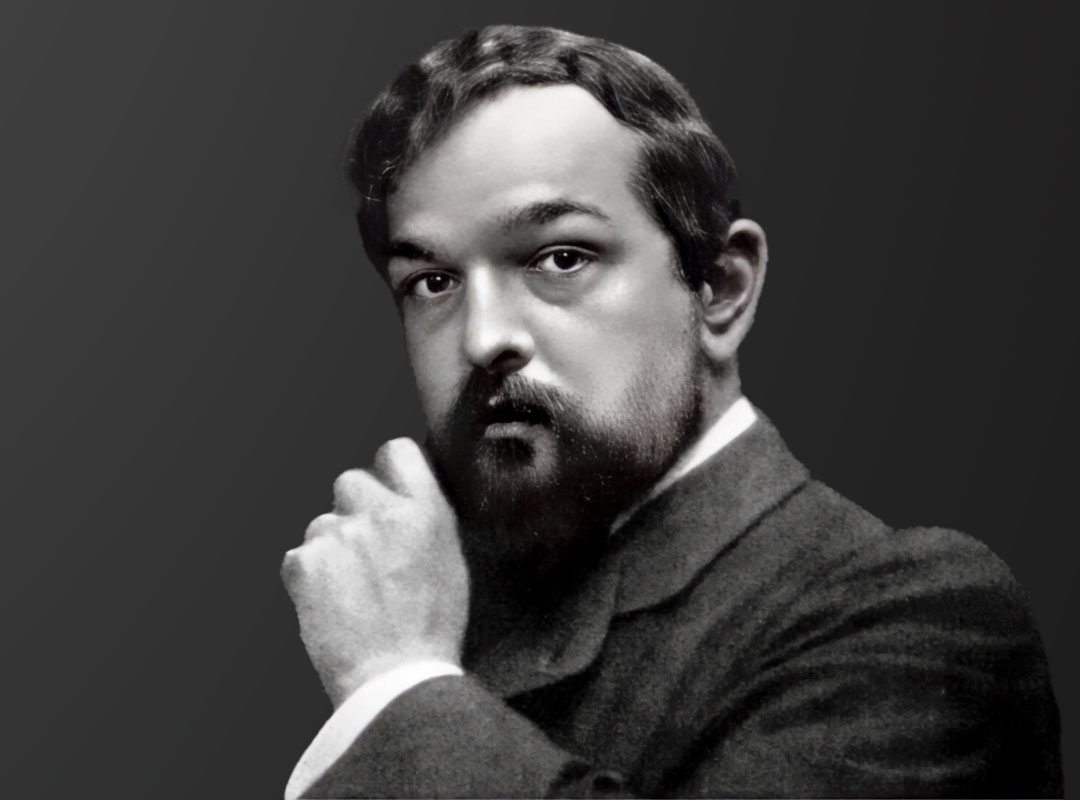
Carolyn and I have appreciated the work of French composer Claude Debussy, who revolutionized Western music by breaking away from traditional tonal structures and pioneering Musical Impressionism. He is best known for his evocative, coloristic harmonies and atmospheric textures that sought to capture moods, sensations, and fleeting impressions rather than strict formal development. His most famous works include Moonlight, Prelude to the Afternoon of a Faun, and the opera Pelléas et Mélisande. Debussy’s innovations in harmony, rhythm, and orchestration profoundly influenced 20th-century music, paving the way for modernism and beyond.
Achille Claude Debussy was born in 1862 in Saint-Germain-en-Laye, France. He was the eldest of five children. Debussy’s father held a variety of modest occupations — he was a shopkeeper who ran a small china and crockery store, later worked as a traveling salesman, and at one point served briefly in the Marine Nationale (French Navy). His mother worked as a seamstress and took care of the family.
When Debussy was around two years old, the family moved to Paris, where they struggled financially. Around the age of five, he began showing musical promise — his first exposure to the piano coming through lessons arranged by his aunt. As a child, Debussy was quiet, introspective, and highly sensitive — traits that later shaped his artistic temperament. He showed little interest in formal schooling but displayed an early fascination with music and the piano, often improvising instead of practicing traditional exercises. Those who knew him described him as imaginative and independent-minded, with a tendency to retreat into his own inner world. His early teachers quickly recognized his exceptional ear and natural musicality, though they also noted his resistance to convention even at a young age.
In 1870, during the Franco-Prussian War, Debussy’s father joined the National Guard and was later imprisoned for political reasons, while Debussy and his mother fled Paris to live in Cannes. During this period, Debussy received piano lessons from an Italian violinist named Jean Cerutti, who recognized his natural talent. After returning to Paris following the war, Debussy’s aunt, Clementine, introduced him to the pianist Madame Maute de Fleurville, a former student of Chopin, who began giving him formal piano instruction around 1872.
In 1872, when Debussy was 10 years old, he started studying at the Paris Conservatoire, where he developed rapidly as a pianist and composer, though his unconventional style often challenged his teachers. He earned early recognition for his technical skill but was criticized for ignoring traditional rules of harmony and form. During this period, Debussy became acquainted with influential figures in the Parisian music world and began composing original works that hinted at his emerging individuality. In 1880, he was hired by the wealthy Russian patroness Nadezhda von Meck, also Tchaikovsky’s patron, as a piano tutor and accompanist for her children — an experience that broadened his exposure to international music and culture.
During the 1880s, Debussy continued his musical education and began gaining recognition as a promising young composer. He spent the summers of 1881 and 1882 traveling with von Meck’s family through Europe and Russia, where he was influenced by Russian composers such as Tchaikovsky and Mussorgsky. In 1884, Debussy won the prestigious Prix de Rome for his cantata The Prodigal Son, earning him a scholarship to study at the Villa Medici in Rome. However, he found the academic environment stifling and left early in 1887. Upon returning to Paris, Debussy became involved with avant-garde artistic circles, exploring new harmonic ideas that would soon define his distinctive, revolutionary musical style.
During the late 1880s and early 1890s, Debussy experienced a creative awakening that defined his mature style. In 1888 and 1889, he visited the Bayreuth Festival in Germany, where Wagner’s music deeply impressed him, though he soon sought a more subtle and atmospheric alternative to Wagner’s grand intensity. The 1889 Paris Exposition Universelle also exposed him to Javanese Gamelan Music, which profoundly influenced his sense of rhythm and harmony. The shimmering, interlocking metallic sounds and cyclical rhythms fascinated him so deeply that he returned repeatedly to listen and study the music. This encounter profoundly changed his approach to composition — he later described Western harmony as “a prison” compared to the freedom and color of what he heard that day. The experience became a turning point in his artistic development, inspiring the fluid, atmospheric style that would define his later works.
During these years, Debussy composed several groundbreaking works, culminating in Prelude to the Afternoon of a Faun in 1894, a sensuous and revolutionary orchestral piece that marked the true beginning of musical Impressionism and established him as a leading modernist voice.
Around this time, Debussy entered a highly productive and transformative phase of his career. He completed his only opera, Pelléas et Mélisande, in 1895, and it premiered in 1902. The opera broke radically from operatic conventions with its subtle, speech-like vocal lines and atmospheric orchestration. During this period, he also composed some of his most important piano works, including the Two Arabesques and the Bergamasque Suite, which contains the famous composition Moonlight. However, Debussy’s personal life was turbulent—he entered and left several relationships, including with Gabrielle Dupont, amid financial struggles — but his reputation in Paris’s artistic circles grew steadily, establishing him as one of the most original composers of his generation.
During the 1900s, Debussy achieved widespread fame and artistic maturity. Pelléas et Mélisande was a sensation — divisive but ultimately celebrated as a landmark in modern music. In the following years, he composed many of his most influential works, including Engravings in 1903, The Sea and Images for Piano, Book I in 1905, and Images for Piano, Book II in 1907, which showcased his mastery of tone color and musical atmosphere. His personal life remained tumultuous: he left his first wife, Rosalie Texier, for Emma Bardac, with whom he had a daughter in 1905. Despite scandal and social backlash, Debussy’s reputation continued to rise, and he was increasingly regarded as France’s leading composer.
In these years, Debussy entered the peak of his creative life while facing growing personal challenges. In 1909, he was diagnosed with cancer, which caused significant physical and emotional strain. Despite this, he composed some of his most refined and innovative works, including Images for Orchestra in 1912, and Préludes and Jeux in 1913. He also began touring as a conductor and pianist, gaining international acclaim for his music. During these years, Debussy’s style became more abstract and harmonically daring, reflecting both his deep introspection and the rapidly changing artistic landscape leading up to World War I.
During the late 1910s, Debussy continued to compose despite his declining health and the turmoil of World War I. Seeking refuge from the war, he spent time in the French countryside and entered a final burst of creativity, producing his late masterpieces known as the Six Sonatas for Various Instruments (though he completed only three). These works show a return to classical clarity and structure, infused with his unique harmonic language. During this period, his cancer worsened, and his physical suffering increased, yet he worked with determination until his final days. As Debussy’s body weakened, his music became ever more inward and transcendent, reflecting the spiritual vision that guided his art throughout his life.
Debussy’s spiritual perspective was deeply individualistic and rooted in a sense of mystery and reverence for nature rather than organized religion. Though raised in Catholic France, he rejected dogma and instead embraced a kind of artistic mysticism — seeing beauty, art, and the natural world as sacred expressions of the ineffable. Influenced by Symbolist Poets and Eastern Philosophies, he sought transcendence through sound, believing music should evoke the unseen and suggest the infinite. For Debussy, spirituality was found not in doctrine but in the subtle, dreamlike realms that music alone could reveal.
In the final year of his life, Debussy was gravely ill and largely confined to his Paris apartment. Despite intense pain, he managed to complete his last major work, the Violin Sonata, which he premiered privately in 1917 and performed publicly in early 1918 — his final appearance as a pianist. As World War I raged and Paris endured German bombardments, his health deteriorated rapidly. Debussy died that year, at the age of 55, and was buried in the Cimetière de Passy. His death marked the end of an era, but his innovations in harmony, tone, and musical atmosphere continued to shape modern music long after his passing.
Debussy’s legacy lies in his profound transformation of Western music. He broke away from traditional tonality and structure, pioneering new harmonic languages, textures, and forms that emphasized color, mood, and suggestion over rigid development. Often seen as the father of Musical Impressionism, he influenced countless composers — from Ravel and Stravinsky to jazz and film composers — through his innovative use of modal scales, unresolved dissonances, and fluid rhythms. His works opened the door to modernism and redefined how music could express emotion and atmosphere, securing his place as one of the most original and influential composers in history.
Here are some of Claude Debussy’s most memorable quotes:
Music is the arithmetic of sounds as optics is the geometry of light.
There is no theory. You have only to listen. Pleasure is the law. I love music passionately. And because l love it, I try to free it from barren traditions that stifle it. It is a free art gushing forth — an open-air art, boundless as the elements, the wind, the sky, the sea. It must never be shut in and become an academic art.
How much has to be explored and discarded before reaching the naked flesh of feeling?
Listen to no one's advice except that of the wind in the trees. That can recount the whole history of mankind.
There is nothing more musical than a sunset. He who feels what he sees will find no more beautiful example of development in all that book which, alas, musicians read but too little— the book of Nature.
Music is the space between the notes.
But music, don't you know, is a dream from which the veils have been lifted. It's not even the expression of a feeling; it's the feeling itself.
There's never one sunrise the same, or one sunset the same.
I love music passionately. And because I love it, I try to free it from barren traditions that stifle it.