
Elizabeth Barrett Browning Profile
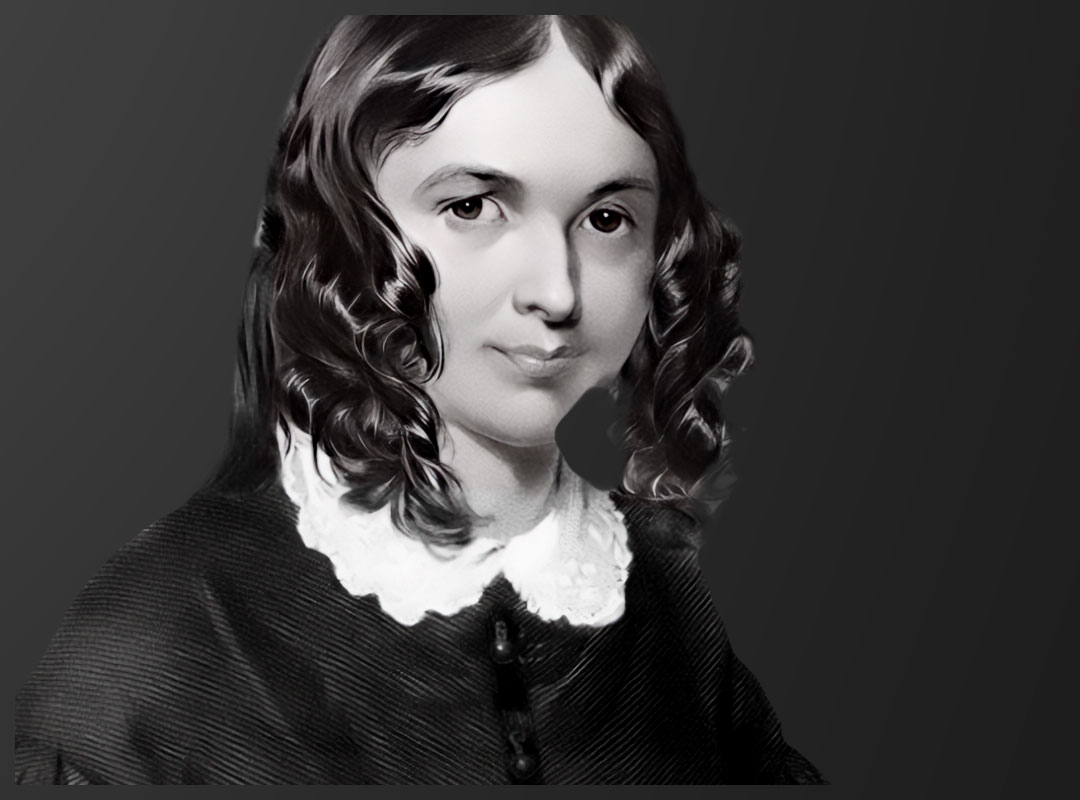
Carolyn and I have long appreciated the work of the English poet Elizabeth Barrett Browning, one of the most prominent poets of the Victorian Era. Despite her lifelong illness, she became internationally celebrated for her innovative poetry, which explored love, social justice, spirituality, and the inner life of women. She is best known for her Sonnets from the Portuguese — especially the famous line “How do I love thee? Let me count the ways” — and for her political epic Aurora Leigh, which championed women’s intellectual and artistic freedom. She also wrote passionately against slavery and child labor, making her one of the earliest major poets to address human rights in her work.
Elizabeth Barrett Browning was born in 1806 in Coxhoe Hall in County Durham, England. Browning’s father managed the family’s considerable wealth, which came largely from sugar plantations and enslaved labor in Jamaica; he oversaw the estates and later moved the family to England to live as the landed gentry. Her mother came from a well-educated, musical family and devoted herself to running the household and raising their children, fostering a cultured, book-filled home that encouraged Browning‘s early love of reading and writing.
Browning was the eldest of twelve children. As a child, she was unusually precocious, sensitive, and intensely bookish. She learned to read early, devoured classical literature, and even began writing poetry while still very young. Though physically delicate and often shy, she was imaginative, thoughtful, and deeply curious about language, ideas, and the natural world around her. Around the age of three, her family moved to the rural Hope End Estate near Ledbury in Herefordshire, where she grew up surrounded by nature. By the end of her early childhood, she was already showing the intellectual curiosity and imaginative gifts that would later shape her life as a poet.
Browning received an unusually rigorous classical education from private tutors, studying Greek and Latin as a child. Her precocious talent blossomed during these years. In 1820, when she was fourteen, her poem The Battle of Marathon was privately printed by her father. During the early 1820s, Browning’s health began to decline — likely after a riding accident and subsequent illnesses — which left her increasingly fragile and dependent on laudanum for pain relief. During this period, she continued her intense studies in Greek and Latin and refined her poetic skills. The family later spent time on the Devon coast at Sidmouth during this time, where Elizabeth continued reading, writing, and developing the poetic voice that would soon make her famous.
Browning emerged publicly as a poet with the publication of An Essay on Mind and Other Poems in 1826, which confirmed her as a serious classical-minded writer. A profound personal loss followed when her mother died in 1828, deepening Browning’s emotional and inner life. During these years, she continued writing and publishing while the family’s financial circumstances worsened, culminating in the sale of their Hope End Estate in 1832 and the family’s move away from the home where she had grown up — an upheaval that marked the end of her youth.
Browning and her family settled in London, where she wrote steadily and became part of the city’s literary world. In 1838, she published The Seraphim and Other Poems, which brought her significant recognition as a poet. During this period, she also developed a debilitating lung condition that confined her increasingly indoors, shaping both her secluded life and the introspective tone of much of her poetry. During the early 1840s, Browning lived a largely secluded life in her family’s London home due to chronic illness, made far worse by the sudden drowning death of her beloved brother Edward in 1840, which left her devastated.
Browning’s Poems, published in 1844, brought major acclaim and caught the attention of the poet Robert Browning, who began writing to her in 1845, after reading her poems and becoming deeply impressed. In his very first letter, Robert boldly declared, “I love your verses with all my heart.” That unexpected note began a secret correspondence. Their exchange of letters soon deepened into a profound emotional and intellectual bond, and it eventually turned into a secret love affair.
Robert’s love, encouragement, and respect helped rekindle Elizabeth’s confidence, joy, and creative vitality after years of illness, grief, and seclusion under her domineering father. In 1846, Elizabeth and Robert married privately against her father’s wishes and left England for Italy, beginning a new and far happier chapter of her life. Their secret marriage — and move to Italy — transformed her life, giving her greater independence, renewed health, and the emotional grounding that inspired some of her greatest poetry. Their partnership became one of the most famous literary love stories in history.
During the late 1840s, Elizabeth settled with Robert in Florence, where the warmer climate improved her health and inspired some of her finest work. In 1849, she gave birth to their only child, Robert Wiedeman Barrett Browning. She became deeply engaged with Italian politics and the Risorgimento Movement, themes that entered her poetry. During this period, she also published the immensely popular Sonnets from the Portuguese in 1850, revealing the inner story of her great love for Robert, and continued to gain international recognition as one of the leading poets of her age.
In 1856, Browning published her major poetic novel Aurora Leigh, a bold exploration of art, women’s independence, and social justice that secured her international fame. Though her health steadily declined, she kept writing and advocating for liberal causes. She spent these years traveling at times between Italy and France, all while remaining a celebrated — and still controversial — public literary voice. Her creative voice during these later years was also deeply shaped by her inner spiritual life, which infused her poetry with moral passion and contemplative depth.
Browning’s spiritual perspective was deeply Christian, but also reflective, questioning, and compassionate rather than dogmatic. She believed in a loving, morally engaged God and saw the spiritual life as woven through human love, conscience, beauty, and creativity. Her poetry often explores faith as a living, evolving relationship with the divine — one that embraces doubt, suffering, and social justice as paths toward greater spiritual insight and moral responsibility.
In her final year, Browning was living in Florence, where her chronic respiratory illness had worsened. She continued to write and remained emotionally invested in Italian politics, though increasingly weakened and confined. Surrounded by her husband and their son, she died peacefully in 1861 and was buried in Florence’s English Cemetery.
Browning’s legacy is that of one of the most influential poets of the Victorian era, whose work expanded both the emotional and intellectual range of English poetry. Her love poetry — especially Sonnets from the Portuguese — set a new standard for intimacy and psychological depth, while Aurora Leigh broke ground in portraying women as independent artists and moral thinkers. She also helped shape a socially engaged literature by writing passionately about slavery, child labor, and political freedom. Browning’s work had a major influence on many prominent writers, including the American poets Edgar Allan Poe and Emily Dickinson. Today she is remembered not only for her lyrical genius, but for helping redefine what a woman poet could be— and what poetry itself could dare to address.
Here are some memorable quotes by Elizabeth Barrett Browning…
How do I love thee? Let me count the ways.
I love thee to the depth and breadth and height
My soul can reach, when feeling out of sight
For the ends of being and ideal grace.
You're something between a dream and a miracle.
No man can be called friendless who has God and the companionship of good books.
I love you not only for what you are, but for what I am when I am with you. I love you not only for what you have made of yourself, but for what you are making of me. I love you for the part of me that you bring out.
My sun sets to rise again.
God's gifts put men's best dreams to shame.
Who so loves believes the impossible.
What we call Life is a condition of the soul. And the soul must improve in happiness and wisdom, except by its own fault. These tears in our eyes, these faintings of the flesh, will not hinder such improvement.