
Federico Fellini Profile
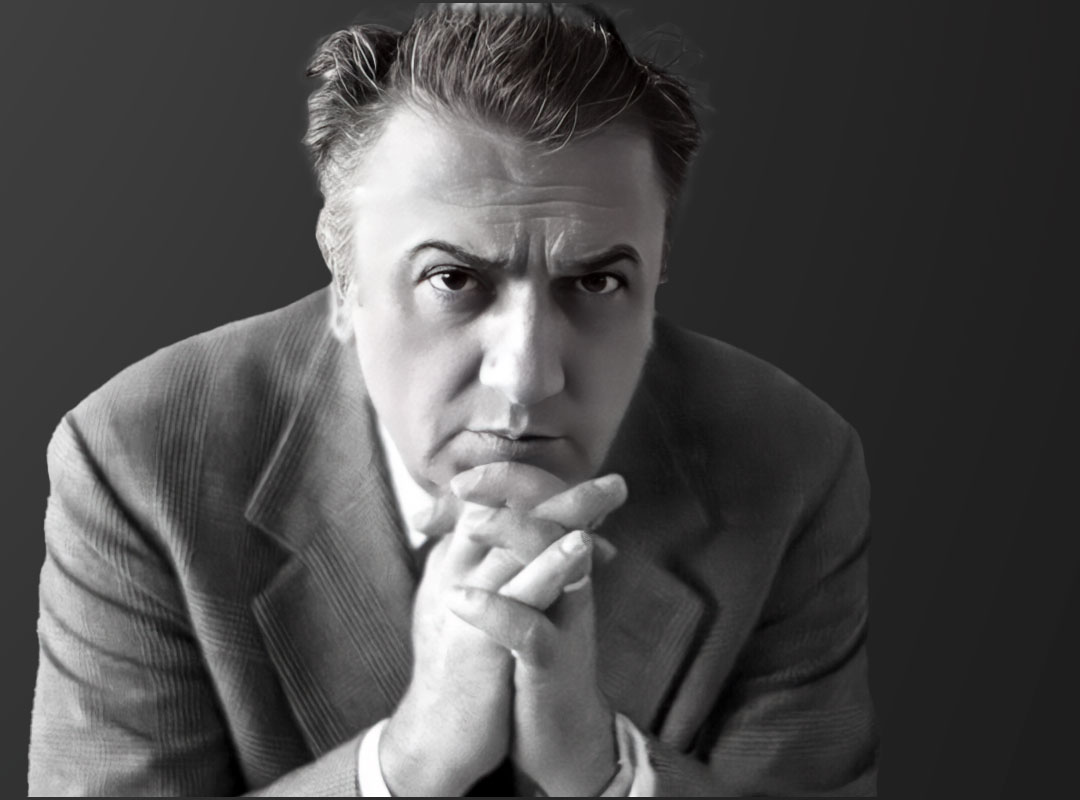
Carolyn and I have appreciated the work of Italian film director and screenwriter Federico Fellini, who was one of the most influential filmmakers of the 20th century, celebrated for blending memory, fantasy, and dreamlike imagery with sharp social commentary. He is best known for classics like La Dolce Vita, which captured the spirit of postwar Rome, and 8½, a groundbreaking exploration of creativity and the artistic process. Over his career, he won four Academy Awards for Best Foreign Language Film — more than any other director — and received an honorary Oscar for lifetime achievement. Fellini’s richly imaginative style, often called Felliniesque, has left a lasting imprint on world cinema.
Federico Fellini was born in 1920 in Rimini, a small coastal town on Italy’s Adriatic coast. His father was a traveling salesman and later a representative for a wholesale food company, often away from home for work. Fellini’s mother came from a Roman Catholic family of middle-class background and was deeply religious, providing him with a strict moral and spiritual upbringing. Their contrasting influences — his father’s worldliness and his mother’s devotion — left an imprint on Fellini’s imagination and the recurring themes of earthly desire and spiritual longing in his films.
As a child, Fellini was imaginative, curious, and drawn to fantasy. His early childhood was shaped by the provincial atmosphere of Rimini, with its blend of seaside carnivals, Catholic rituals, and local characters that later inspired his films. Fellini developed a passion for drawing and caricature, often sketching teachers and classmates. He became an avid reader of adventure stories, comic books, and satirical magazines, which sharpened his taste for humor and exaggeration. Fellini also fell in love with the world of the circus and traveling performers, sneaking away to watch clowns and vaudeville shows — experiences that left a deep imprint on his imagination. By the early 1930s, he was already earning small amounts by selling caricatures to tourists, showing both his artistic talent and entrepreneurial flair at a young age.
When Fellini entered his teenage years, he began refining his artistic ambitions. He continued to sell caricatures and cartoons to local shops and newspapers in Rimini, gaining recognition for his humor and draftsmanship. In 1937, he moved to Florence and then to Rome, officially to study law but more passionately to pursue journalism and illustration. There, he contributed cartoons and satirical sketches to magazines such as Marc’Aurelio, a popular humor publication. These experiences in Rome exposed him to the cultural life of the city and marked the beginning of his professional path as a writer and artist, paving the way toward cinema.
During the early 1940s, Fellini established himself in Rome as a writer and humorist, contributing stories, cartoons, and gags to magazines and radio shows. During World War II, he supported himself by writing comic sketches and scripts, and in 1943, he married actress Giulietta Masina, who became both his life partner and frequent collaborator. Fellini began working in film by providing gags and co-writing screenplays, most notably for Roberto Rossellini’s Rome, Open City in 1945, a landmark of Italian Neorealism.
While working with Rossellini on Rome, Open City, Fellini was asked to help find extras for a scene. He recruited local children and even coaxed a passerby into participating, improvising on the spot — an approach that revealed his gift for blending real life with cinema. This spontaneous experience not only contributed to the film’s authenticity but also gave Fellini his first taste of the directing process, sparking his desire to move from screenwriting to filmmaking.
In 1950, Fellini co-directed his first feature film, Variety Lights, with Alberto Lattuada, followed by his solo debut, The White Sheik in 1952, which introduced his blend of comedy, satire, and dreamlike imagery. In 1953, Fellini achieved international success with I Vitelloni, a semi-autobiographical film about small-town youth, which won the Silver Lion at the Venice Film Festival. During the 1950s, Fellini rose to worldwide prominence. In 1954, his film La Strada, starring Masina, won the Academy Award for Best Foreign Language Film and established his international reputation. He followed with Il Bidone in 1955 and the beloved Nights of Cabiria, in 1957, which also won an Oscar.
Around this time, Fellini became deeply interested in psychologist Carl Jung’s ideas, especially Jung’s concepts of archetypes and the collective unconscious, which resonated with his own fascination with dreams and symbols. In 1960, Fellini met Jungian psychoanalyst Ernst Bernhard, who recommended that he keep a record of his dreams, and in 1963, he read Jung's autobiography, Memories, Dreams, Reflections. Fellini underwent Jungian analysis, keeping dream journals that shaped the imagery and structure of films like 8½ and Juliet of the Spirits. At Bernhard’s recommendation, Fellini also started experimenting with the I Ching, consulting it for guidance and inspiration, which reinforced his sense of synchronicity and the mysterious interplay between fate and imagination. Both Jung’s psychology and the I Ching encouraged Fellini to trust the irrational and symbolic, helping him create films that feel like journeys through the unconscious.
Dreams and the unconscious were at the heart of Fellini’s artistic vision. He saw dreams as direct expressions of the unconscious, rich with symbols and archetypes, and he recorded his own dreams extensively in illustrated journals. These inner landscapes flowed into his films, where logic often gives way to dreamlike sequences, surreal imagery, and shifting realities. By drawing on the unconscious, Fellini created cinema that feels both deeply personal and universally resonant, inviting viewers into a poetic space between waking life and dream.
In 1960, Fellini released La Dolce Vita, a groundbreaking portrait of Rome’s nightlife and moral drift, which won the Palme d’Or (“Golden Palm”), the most prestigious award at the Cannes Film Festival, and became one of the most influential films of the century. This period firmly secured Fellini as one of the leading figures in world cinema. During the 1960s, Fellini reached the height of his artistic innovation. In 1963, he released 8½, a dazzling, semi-autobiographical film about a director’s creative block, which won the Academy Award for Best Foreign Language film and is often hailed as one of the greatest movies ever made.
Curious about its potential to expand perception, Fellini experimented with LSD in the mid-1960s under medical supervision. In 1964, Fellini took LSD under the supervision of his psychoanalyst. He described the experience as profoundly unsettling but also illuminating, intensifying his fascination with dreams, archetypes, and the blurred boundaries between reality and imagination. The trip reinforced themes already present in his work — surreal imagery, shifting identities, and dream logic. It confirmed for him that the unconscious was a vast reservoir of imagery, which he continued to explore cinematically without further use of psychedelics.
In 1965, Fellini released Juliet of the Spirits, his first color feature, starring Masina in a visionary exploration of a woman’s inner world. By the mid-1960s, Fellini was celebrated globally as a master of modern cinema, and the term “Felliniesque” had entered the cultural lexicon to describe his unique blend of fantasy, memory, and surreal spectacle.
During the late 1960s and early 1970s, Fellini continued to push further into surrealism and spectacle. In 1969, he made Fellini Satyricon, a hallucinatory adaptation of Petronius’ ancient Roman text, which stunned audiences with its bizarre imagery. This was followed by The Clowns in 1970, a playful TV film about his lifelong fascination with circus performers, and Roma, in 1972, a semi-autobiographical portrait of the Eternal City. In 1973, he created Amarcord, a nostalgic, dreamlike evocation of his youth in Rimini, which won the Academy Award for Best Foreign Language Film.
In the late 1960s and 1970s, Fellini developed a strong interest in parapsychology, Spiritism, and séances, exploring concepts such as telepathy, clairvoyance, and communication with the dead. He attended séances, consulted psychics, and even used tarot and other forms of divination as creative prompts. This interest coincided with his growing fascination with dreams, Jungian archetypes, and the occult, all of which influenced the mystical and surreal textures of films like Juliet of the Spirits and Amarcord. For Fellini, these explorations were less about literal belief than about expanding his imaginative access to the unseen layers of reality.
Fellini’s spiritual perspective was shaped by his Catholic upbringing, but he approached religion with ambivalence, mixing reverence with irony. He was fascinated by rituals, symbols, and the mystery of existence, often portraying the sacred and the profane side by side. Fellini believed more in imagination, dreams, and art as paths to truth than in formal doctrine, treating creativity itself as a spiritual act. His films suggest that the divine reveals itself through life’s absurdities, fantasies, and longings, making spirituality inseparable from the human imagination.
During the late 1970s, Fellini continued to create ambitious and controversial works. In 1976, he released Casanova, a visually stunning but somber take on the legendary lover, which divided critics yet showcased his mastery of spectacle. He followed with Orchestra Rehearsal in 1978, a television film using a rehearsal as an allegory for political chaos in Italy. In 1980, he directed City of Women, starring Marcello Mastroianni, a surreal exploration of feminism and male identity. Though reactions were mixed, these films demonstrated Fellini’s fearless experimentation and his ongoing commitment to pushing the boundaries of cinematic form.
During the 1980s, Fellini entered the later phase of his career with works that blended personal reflection and dreamlike imagery. In 1983, he directed And the Ship Sails On, a satirical fable set on a luxury liner that was praised for its visual inventiveness. In 1985, I was blessed to be able to see Fellini in person with my mom at the Avery Fisher Hall in Lincoln Center, where he was honored by the New York Film Society as the Gala Tribute honoree. In 1986, Fellini released Ginger and Fred, reuniting Masina and Marcello Mastroianni as aging television performers confronting modern media culture. In 1987, he released Intervista, a playful, semi-autobiographical film about his own career, which won the Cannes 40th Anniversary Prize.
During the early 1990s, Fellini created his final major film and received wide recognition for his lifetime achievements. In 1990, he directed The Voice of the Moon, starring Roberto Benigni, a poetic meditation on dreams and madness, which would be his last feature film. During these years, Fellini was celebrated internationally, receiving numerous tributes and retrospectives honoring his career. In 1992, he was awarded an honorary Golden Lion at the Venice Film Festival, acknowledging his unparalleled influence on world cinema.
In 1993, Fellini received the Academy Award for Lifetime Achievement, a tribute to his extraordinary impact on world cinema. Later that year, he suffered a heart attack and died at the age of 73, in Rome, just one day after celebrating his 50th wedding anniversary with Masina. His funeral drew massive crowds, reflecting his stature as one of Italy’s most beloved and influential artists.
Fellini’s legacy is that of one of cinema’s greatest visionaries, whose films redefined the art form by blending memory, dream, fantasy, and social satire into a unique, poetic style. He expanded the language of film beyond Neorealism into deeply personal, surreal, and symbolic realms, inspiring generations of directors worldwide. The adjective “Felliniesque” has become shorthand for the magical, the grotesque, and the fantastical in storytelling. Through masterpieces like La Strada, 8½, and La Dolce Vita, Fellini left an enduring imprint on world culture, shaping how cinema can explore the human condition.
Here are some of Federico Fellini’s most memorable quotes:
All art is autobiographical; the pearl is the oyster's autobiography.
There is no end. There is no beginning. There is only the infinite passion of life.
If there were a little more silence, if we all kept quiet...maybe we could understand something.
Don't tell me what I'm doing; I don't want to know.
A different language is a different vision of life.
Censorship is advertising paid by the government.
Put yourself into life and never lose your openness, your childlike enthusiasm throughout the journey that is life, and things will come your way.
An artist is a provincial who finds himself somewhere between a physical reality and a metaphysical one. It’s this in-between that I’m calling a province, this frontier country between the tangible world and the intangible one. That is the realm of the artist.
Going to the cinema is like returning to the womb; you sit there still and meditative in the darkness, waiting for life to appear on the screen. One should go to the cinema with the innocence of a fetus.