
Georgia O’Keeffe Profile
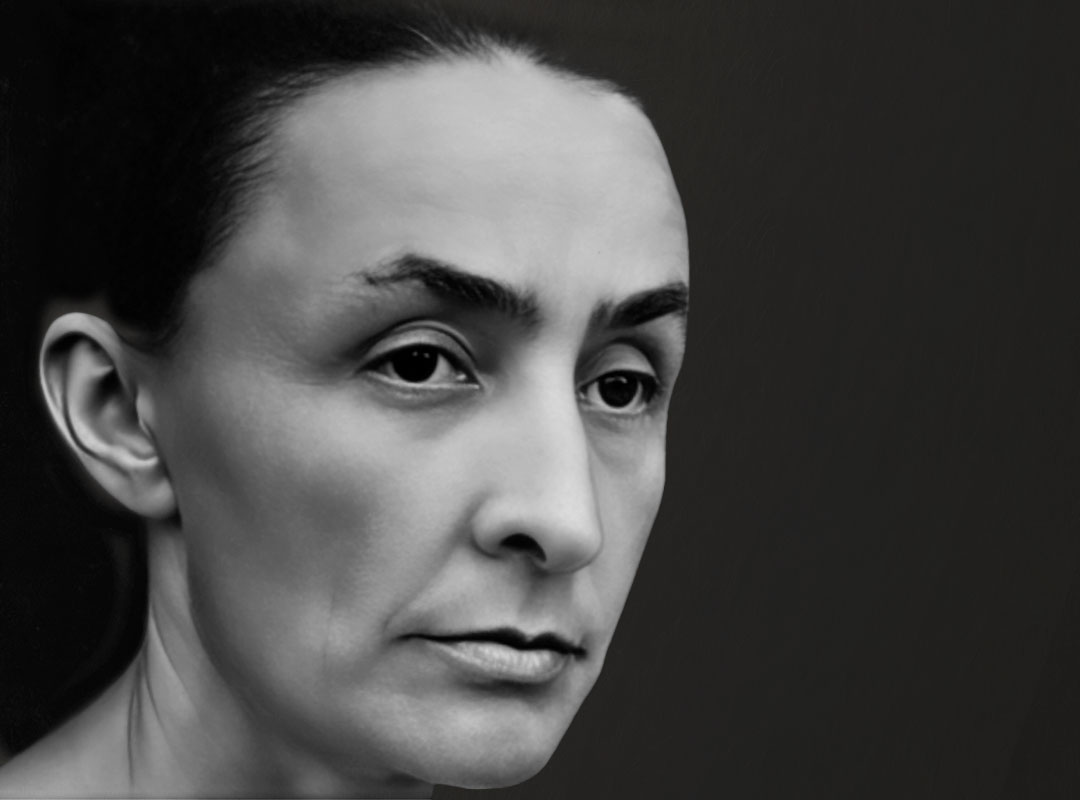
Carolyn and I have admired the work of modernist artist Georgia O'Keeffe, whose work was largely independent of any prevailing art movements. O'Keeffe gained international recognition for her uniquely crafted paintings of natural forms, particularly flowers, skulls, and landscapes inspired by desert settings, which were often drawn from and related to environments in which she lived, and the profound connection that she had to them.
Georgia O'Keeffe was born in 1887 in Sun Prairie, Wisconsin. Her parents were dairy farmers. She was the second of seven children, and she was named Georgia after her maternal grandfather, George Victor Totto, who was a Hungarian count.
O'Keeffe attended Town Hall School in Sun Prairie, and by the age of ten she had decided that she wanted to become an artist. O'Keeffe's artistic journey began to unfold when she and two of her sisters received instruction from a local watercolor artist. In 1902 the O'Keeffe family moved to Williamsburg, Virginia, where her father began a business making cast concrete blocks for the anticipated building trade.
In 1905 O'Keeffe graduated from the Chatham Episcopal Institute in Virginia. From 1905 to 1906 O'Keeffe studied at the School of Art Institute of Chicago, where she ranked at the top of her class, and in 1907 she attended the Art Students League in New York City. From 1908 to 1910 O'Keeffe worked as a commercial artist in Chicago. In 1911 she began teaching art at her former school, the Chatham Episcopal Institute in Virginia. From 1912 to 1914 she taught art at public schools in Texas, and took more art classes at the University of Virginia and Columbia University.
In 1916 O'Keeffe had ten of her drawings exhibited at the internationally famous 291 Gallery in New York City. That same year O'Keeffe became the chair of the art department at West Texas State Normal College where she also taught. It was around this time when O'Keeffe really began her own paintings, and began to express her “most private sensations and feelings” on canvas. She enjoyed sunrises and sunsets, but then developed a fondness for nocturnal colors.
O'Keeffe experimented with watercolors, and freely painted landscape imagery in her work, without sketching out the design before painting. In 1917 she painted Light Coming on the Plains No. 1, which she believed “truly captured her feelings.” O'Keeffe began a series of watercolors based upon the scenery and expansive views during her walks in the Palo Duro Canyon in the Texas panhandle.
In 1918 O'Keeffe began a close personal relationship with the well-known photographer Alfred Stieglitz, who provided financial support for her, and arranged for her to have a place of residence in New York to paint. Stieglitz also promoted O'Keeffe’s work and introduced her to a circle of Modernist artists, who painted more abstract art and rejected realism in their work. O'Keeffe stopped painting watercolors after Stieglitz’s encouragement to do so, because of its “association with amateur women artists.”
O'Keeffe began painting more abstract art, and started creating simplified images of organic and natural objects, such as leaves, flowers, and rocks. She started creating close-ups of flowers, which became her trademark style and what she is most known for. The flowers have a deep sensuality that borders on being sexual, and many look like woman’s vulvas, although O'Keeffe repeatedly denied that this similarity to female genitalia was intentional.
In 1925 O'Keeffe moved into a 30th floor apartment in New York City and began painting city skyscrapers and skylines. In 1927 the Brooklyn Museum held a retrospective of her work, and O'Keeffe received a lot of press attention, which increased the value of her work.
In 1929 O'Keeffe travelled to Santa Fe and Taos, New Mexico, and she began spending time there, which she continued to do for the rest of her life, dividing her time between Taos and New York City. O'Keeffe regularly exhibited her work at the Stieglitz Gallery in New York, and spent part of her year working in New Mexico, where she had a room with a view of the Taos Mountains.
O'Keeffe spent much of her time alone when she was in New Mexico, and she collected rocks and bones from the desert, which she used with the landscape forms there in her work. In 1940 she had retrospectives at the Art Institute of Chicago, and in 1946 she was the first woman artist to have a retrospective at the Museum of Modern Art in New York City.
In 1972 O'Keeffe lost much of her eyesight due to macular degeneration and stopped oil painting without assistance. She hired a live-in caregiver who taught her how to work with clay, encouraged her to continue painting, and helped her write an autobiography. In 1976 her autobiography Georgia O'Keeffe was published, and she began working in watercolors again, as well as with pencil and charcoal.
O'Keeffe received numerous, highly prestigious awards. In 1977, President Gerald Ford presented O'Keeffe with the Presidential Medal of Freedom, the highest honor awarded to American civilians. In 1985, she was awarded the National Medal of Arts by President Ronald Reagan, and in 1993, she was inducted into the National Women's Hall of Fame.
O'Keeffe died in 1986 at the age of 98. She painted over 900 paintings during her lifetime.
In 1997 the Georgia O'Keeffe Museum opened in Santa Fe, which houses a large body of her work, as well as photographs and archival materials. In 1998 her home and studio in Abiquiú, New Mexico was designated a National Historic Landmark. In 1996, the U.S. Postal Service issued a 32-cent stamp honoring O'Keeffe, and in 2014, her painting Jimson Weed/White Flower No 1 sold for over $44 million, which was more than three times the previous world auction record for any female artist.
Some of the quotes that Georgia O'Keeffe is known for include:
My painting is what I have to give back to the world for what the world gives to me.
I found I could say things with color and shapes that I couldn't say any other way... things I had no words for.
I have but one desire as a painter– that is to paint what I see, as I see it, in my own way, without regard for the desires or taste of the professional dealer or the professional collector.
It's not enough to be nice in life. You've got to have nerve.
I've been absolutely terrified every moment of my life, and I've never let it keep me from doing a single thing that I wanted to do.
I decided to accept as true my own thinking.
If you take a flower in your hand and really look at it, it's your world for a moment.
To create one's world in any of the arts takes courage.
Nothing is less real than realism. Details are confusing. It is only by selection, by elimination, by emphasis, that we get at the real meaning of things.