
J.R.R. Tolkien Profile
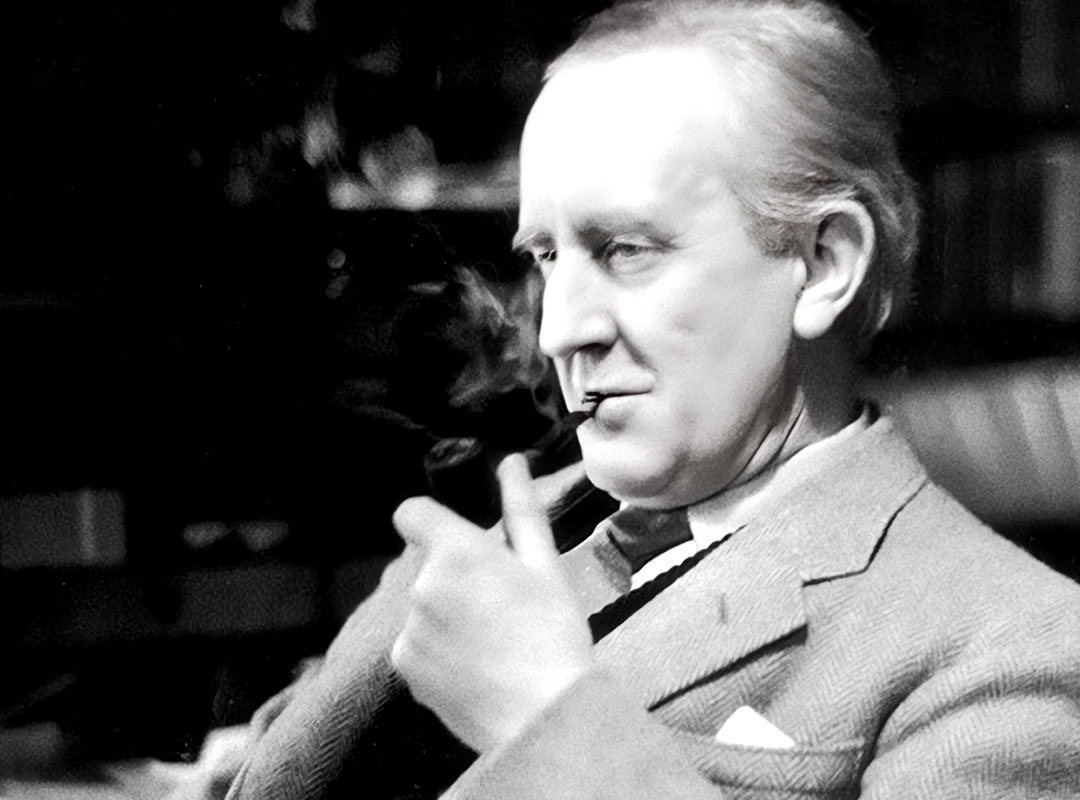
Carolyn and I have appreciated the work of English writer, Oxford University professor, and language historian (philologist) J.R.R. Tolkien, who was one of the most influential writers of the 20th century. Tolkien’s most important achievements lie in creating the richly detailed world of Middle-earth through The Hobbit and The Lord of the Rings trilogy. He is best known for pioneering the modern genre of high fantasy, blending mythology, linguistics, and storytelling into an epic vision that has inspired countless writers, films, and cultural works. Beyond his fiction, Tolkien was also an esteemed scholar of Old and Middle English literature, contributing significant academic work.
John Ronald Reuel Tolkien was born in Bloemfontein, South Africa, in 1892. Tolkien’s father was an English banker who moved to Bloemfontein to manage a branch of the Bank of Africa. His mother, also English, was a gifted and independent-minded woman who managed the household. In 1896, when Tolkien was three, his mother took him and his brother back to England for a visit; during their stay, his father died suddenly of rheumatic fever in South Africa, leaving the family without support. This loss led them to settle permanently in England, where his mother raised the boys largely on her own, instilling in them a love of language, stories, and nature that shaped Tolkien’s lifelong passions and that became the foundation of his creative world.
Tolkien’s early years were marked by the heat and strangeness of the South African landscape, an environment he later said influenced some of the darker, more exotic imagery in his writing. As a child, Tolkien was bright, imaginative, and deeply curious, with a strong love of language and storytelling. He showed an early gift for drawing and inventing imaginary worlds, as well as a fascination with plants and the natural world, which he explored with his mother and brother. He was also precocious with words — learning to read very young, delighting in the sound of languages, and even beginning to invent his own.
In 1900, Tolkien’s mother converted to Catholicism, a decision that caused tension with her Protestant family but profoundly shaped Tolkien’s own faith. That same year, he entered King Edward’s School in Birmingham, beginning his formal classical education. In 1904, tragedy struck again when his mother died of complications from diabetes at just 34 years old, leaving Tolkien and his brother orphaned; they came under the guardianship of Father Francis Morgan, who guided their upbringing.
Tolkien and his brother lived under the care of Morgan, boarding with various families while continuing their education. At King Edward’s School in Birmingham, he excelled in languages and literature, mastering Latin and Greek, and continuing to invent his own languages. In 1908, the brothers moved to lodgings where Tolkien met Edith Bratt, with whom he formed a deep bond that would later inspire the love story of Beren and Lúthien. In 1911, Tolkien began his studies at Exeter College, Oxford, focusing on the Classics before switching to English Language and Literature. That same year, he also joined a school walking tour in Switzerland, an experience that later inspired the landscapes in The Hobbit.
In 1913, Tolkien reunited with Bratt, and they became engaged. They married in 1916, shortly before he was sent to the Western Front as a British officer in World War I. While serving as a young officer, Tolkien wrote love letters to Bratt from the trenches of the Battle of the Somme. During one of his sick leaves that year, Bratt once danced for him in a woodland glade filled with white flowers — a moment so moving that Tolkien later wove it into his mythology as the Tale of Beren, which became the foundation for one of the most beautiful and enduring love stories in The Silmarillion. Tolkien endured horrific trench conditions, lost close friends from his school circle, and contracted trench fever, which eventually led to his return to England.
During the early 1920s, Tolkien recovered from wartime illness and began building both his academic career and family life. He worked briefly on the Oxford English Dictionary, contributing to entries on Germanic words, then became a lecturer in English at the University of Leeds in 1920, where he co-wrote a still-respected translation of Sir Gawain and the Green Knight. He and Bratt welcomed four children during this period, and Tolkien delighted in creating stories for them — early seeds of The Hobbit. In 1925, he returned to Oxford University as a Professor of Anglo-Saxon, marking the start of his long, influential tenure there.
During the late 1920s, Tolkien settled into his role as Professor of Anglo-Saxon at Oxford University, where he became a highly respected scholar of Old English and Norse Literature. In 1926, he met British writer C.S. Lewis, sparking a close friendship and the beginnings of the Inklings Literary Circle that would profoundly shape both writers’ works. The Inklings were an informal Oxford literary circle of writers and scholars who met regularly in the 1930s and 40s to share, critique, and inspire each other’s works. Tolkien continued developing his private “legendarium,” refining the myths and languages of Middle-earth, and began sharing these stories with friends and family. By the early 1930s, he was also inventing whimsical tales for his children — work that soon grew into the manuscript of The Hobbit.
During the 1930s, Tolkien deepened his literary work while balancing academic duties at Oxford University. He continued developing The Hobbit, which was published in 1937 to wide acclaim, bringing him unexpected fame. The Hobbit is the story of Bilbo Baggins, a comfort-loving hobbit (a small, human-like being with furry feet), who is swept into a dangerous quest with a band of dwarves and the wizard Gandalf to reclaim a stolen treasure, discovering courage, wisdom, and the wider world beyond his quiet home.
Encouraged by the success of The Hobbit, Tolkien’s publisher requested a sequel, prompting him to begin writing The Lord of the Rings. During this time, he also expanded The Silmarillion mythos, though publishers hesitated to accept it. By the outbreak of World War II in 1939, Tolkien was recognized not only as a distinguished philologist but also as a rising force in modern fantasy literature.
During the early 1940s, Tolkien lived through the turbulence of World War II while continuing his academic and creative work. Too old to serve, he contributed to the war effort by serving in the Home Guard and by continuing his teaching at Oxford University, where wartime disruptions made academic life difficult. Throughout these years, he labored steadily on The Lord of the Rings, expanding it from a children’s sequel into an epic saga. By 1946, the manuscript was largely complete, though revisions and negotiations with publishers would continue for years. The Lord of the Rings is an epic tale of friendship, courage, and sacrifice, following a fellowship’s struggle to destroy the One Ring (a powerful, corrupting artifact forged by the dark lord Sauron to control all of Middle-earth) and defeat Sauron to save Middle-earth.
During the late 1940s and early 1950s, Tolkien focused intensely on finishing and revising The Lord of the Rings, a process that grew increasingly complex as the work expanded in scope and depth. He struggled with perfectionism, frequent rewrites, and difficulties with publishers, who were uncertain about the book’s length and audience. At the same time, he continued teaching at Oxford University and remained active with the Inklings, though the group began to meet less often. By 1953, he had finally completed the massive manuscript, setting the stage for its historic publication the following year.
During the late 1950s, Tolkien achieved worldwide fame with the publication of The Lord of the Rings, a trilogy that quickly established him as the father of modern high fantasy. The work’s success brought both acclaim and an overwhelming amount of correspondence from fans, which he found difficult to manage alongside his teaching duties at Oxford University. During this time, he continued refining The Silmarillion materials, though they remained unpublished, and he began to feel the strain of balancing scholarship, creative writing, and sudden celebrity. By the end of the decade, Tolkien was celebrated internationally, although he was still somewhat ambivalent about the immense attention his epic had brought him.
In 1963, Tolkien entered retirement from his Oxford University professorship, which allowed him more time to focus on his writing. He continued revising The Silmarillion and other Middle-earth legends, though he struggled to bring them to a publishable form. His fame grew steadily, especially in America, where The Lord of the Rings became a cult classic among students and the counterculture, elevating him to near-mythic status. In 1967, he published The Road Goes Ever On (with Donald Swann) and saw the release of Smith of Wootton Major, one of his last major fairy stories.
In 1968, Tolkien and his wife moved from Oxford to the coastal town of Bournemouth, seeking a quieter life away from the pressures of fame and fan attention. Despite the change, his reputation as a cultural icon continued to grow, particularly as The Lord of the Rings spread widely in paperback editions. He kept working on refining The Silmarillion manuscripts, though age and declining health slowed his progress. In these years, he also enjoyed the recognition of honors, including being named a Commander of the Order of the British Empire in 1972, a formal acknowledgment of his literary achievement.
In 1973, Tolkien faced declining health while continuing to oversee and revise his vast legendarium. That year, his beloved wife passed away, leaving him deeply bereft. Just months later, Tolkien himself died in Bournemouth at the age of 81. He was buried alongside his wife in Oxford, their shared gravestone inscribed with the names “Beren” and “Lúthien,” symbolizing the enduring love story at the heart of his mythology.
The Silmarillion, published posthumously in 1977, is a mythic history of Middle-earth that tells of its creation, the rise and fall of the Elves, and the ancient wars over the radiant jewels called the Silmarils. Its sweeping myths also reflect Tolkien’s profound spiritual vision, which deeply informed the moral and symbolic fabric of his work.
Tolkien’s spiritual perspective was deeply rooted in his devout Roman Catholic faith, which he held throughout his life as a guiding force. He saw the world as infused with divine order and believed in the importance of moral choices, humility, and the struggle between good and evil. His faith subtly permeated his writings — not through direct allegory, but through themes of providence, sacrifice, resurrection, and the redemptive power of love and mercy.
Tolkien’s legacy lies in transforming modern literature by creating The Hobbit, The Lord of the Rings, and his vast mythology of Middle-earth, which established high fantasy as a major genre. His deep knowledge of languages, myth, and storytelling gave his works a unique richness that has inspired generations of writers, artists, filmmakers, and readers worldwide. Beyond his fiction, his scholarship on medieval literature remains influential, and his mythic vision continues to shape how people imagine epic worlds, heroism, and the power of language.
Tolkien’s works have inspired several major film adaptations, most famously Peter Jackson’s The Lord of the Rings trilogy, which was released as three films: The Fellowship of the Ring in 2001, The Two Towers in 2002, and The Return of the King in 2003. These films were both a critical and commercial triumph, winning 17 Academy Awards across the three films, including Best Picture for The Return of the King. Jackson’s The Hobbit trilogy, released between 2012 and 2014, was also successful at the box office, though critics felt it was overextended compared to the source material. Earlier, there were animated adaptations: Ralph Bakshi’s The Lord of the Rings in 1978, and Rankin/Bass’s The Hobbit in 1977 and The Return of the King in 1980, which received mixed reactions but gained cult followings. Overall, the films introduced Tolkien’s world to vast new audiences, cementing his stories as cultural touchstones.
Here are some of J.R.R. Tolkien’s most memorable quotes:
Some believe that only great power can hold evil in check, but that is not what I have found. It is the small everyday deeds of ordinary folk that keep the darkness at bay. Small acts of kindness and love.
All that is gold does not glitter. Not all those who wander are lost.
I wish it need not have happened in my time. (said Frodo)
So do I, and so do all who live to see such times. But that is not for them to decide. All we have to decide is what to do with the time that is given us. (said Gandalf)
If more of us valued food and cheer and song above hoarded gold, it would be a merrier world.
There is nothing like looking, if you want to find something. You certainly usually find something, if you look, but it is not always quite the something you were after.
The world is indeed full of peril, and in it there are many dark places; but still there is much that is fair, and though in all lands love is now mingled with grief, it grows perhaps the greater.
Where there's life there's hope.
End? No, the journey doesn't end here. Death is just another path, one that we all must take. The grey rain-curtain of this world rolls back, and all turns to silver glass, and then you see it… White shores, and beyond, a far green country under a swift sunrise.