
Jane Fonda Profile
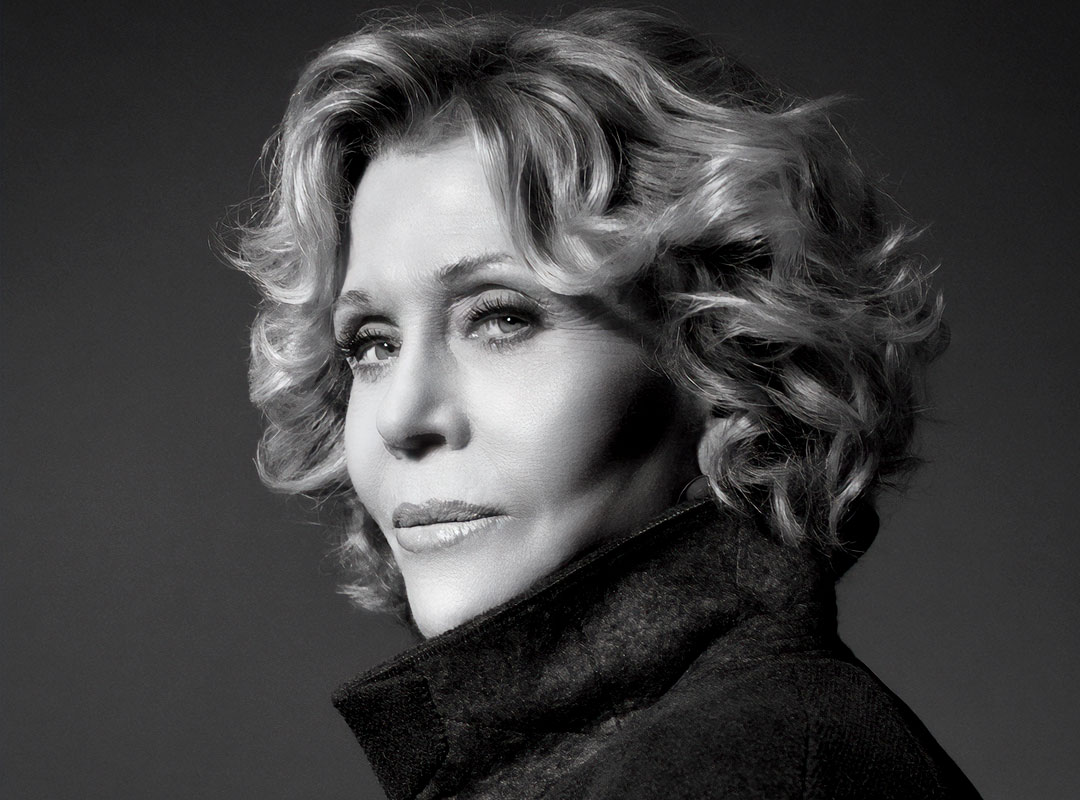
Carolyn and I have appreciated the work of Academy Award–winning actress, political activist, and fitness icon Jane Fonda, a rare cultural shapeshifter whose life has unfolded in bold and unexpected chapters across more than six decades. Fonda won two Oscars — for Klute in 1971 and Coming Home in 1978 — and is also widely known for her roles in films such as Barbarella, 9 to 5, and On Golden Pond. Yet her legacy extends far beyond the screen. She became a lightning rod for controversy due to her outspoken opposition to the Vietnam War, earning the nickname “Hanoi Jane,” and in the 1980s, she reinvented herself yet again through her groundbreaking workout empire, helping to redefine fitness culture. In recent decades, she has continued to evolve — remaining active in film and television, while deepening her advocacy work around feminism, environmental issues, and social justice.
Jane Fonda was born in 1937 in New York City. Her father, Henry Fonda, was one of the most respected actors of Hollywood’s Golden Age, and celebrated for his portrayals of principled, quietly strong characters. Her mother, Frances Ford Seymour, was a Canadian-born socialite and model who moved in elite artistic and social circles in New York and Hollywood. She was not a professional actress but was known for her beauty and social prominence within high society.
Fonda’s early childhood was shaped by her father’s rising Hollywood career, which meant frequent moves between New York and Los Angeles and exposure to the film world from infancy. During her first five years, the family’s public glamour contrasted with private instability, as her mother struggled with emotional and mental health difficulties — tensions that would later have a profound impact on Fonda’s life.
Fonda has described herself as a sensitive, eager-to-please, and somewhat insecure child who longed for approval — especially from her emotionally reserved father. She grew up in a household marked by glamour on the surface but emotional distance and instability underneath, which left her feeling uncertain about her own worth. As a young girl, she was athletic and spirited, yet inwardly anxious and self-critical — traits she later said shaped both her struggles with self-esteem and her lifelong drive for achievement and reinvention.
Fonda experienced profound upheaval in 1950, when she was 12, and her mother died by suicide. Fonda has described her mother’s suicide as the most formative trauma of her life. At the time, she was told that her mother had died of a heart condition, and she did not learn the truth until later — an experience that deepened her feelings of confusion, abandonment, and emotional isolation. Fonda has said the loss shaped her lifelong struggles with self-worth, perfectionism, and eating disorders. In later years, however, she came to understand her mother’s death through the lens of mental illness rather than personal rejection, a shift that contributed to her emotional healing and spiritual growth.
In the years that followed, Fonda’s father remarried, and she was sent to boarding school, at the prestigious Emma Willard School in Troy, New York, where she participated in drama and graduated in 1955. After this, she attended Vassar College, but she struggled with self-esteem and began battling bulimia, a condition that would affect her for years. In 1957, Fonda traveled to Paris, where exposure to European culture broadened her worldview. Fonda left Vassar without graduating and began studying acting at the Actors Studio under Lee Strasberg — marking the decisive turn toward the career that would define her public life.
After studying with Strasberg at the Actors Studio, Fonda made her Broadway debut in There Was a Little Girl in 1960, earning a Tony nomination, and that same year transitioned into film with Tall Story. During the early 1960s, Fonda quickly became a rising Hollywood star, appearing in films such as Period of Adjustment and Sunday in New York. In 1963, she married French director Roger Vadim, which soon led her to relocate to France and take on more provocative, internationally visible roles.
In 1968, Fonda starred as a space traveler in the cult classic science fiction film Barbarella, which cemented her international fame and sex-symbol status. By the late 1960s, however, she began moving away from glamorous roles and became increasingly politicized, speaking out against the Vietnam War and social injustice. During the 1970s, Fonda transitioned into a more serious phase of her acting career and activism.
In 1971, Fonda won an Academy Award for Best Actress in the psychological thriller Klute, and in 1972, she famously traveled to North Vietnam during the war, where she was photographed sitting on an anti-aircraft gun — an image that sparked intense outrage and lasting backlash, because many Americans viewed this as a betrayal of U.S. troops. This earned her the nickname “Hanoi Jane,” a label that would follow her for decades. Fonda later expressed deep regret for posing for the photograph, calling it a painful mistake that overshadowed her broader antiwar message. The incident became one of the most controversial moments in celebrity political activism and has followed her for decades as both a defining and cautionary episode in her life.
In 1973, Fonda got a divorce from Vadim and married activist Tom Hayden. In 1976, Fonda and Hayden co-founded the political organization Campaign for Economic Democracy, a California-based committee advocating rent control, environmental protections, solar energy investment, labor rights, women’s rights, and anti-nuclear initiatives. Around this time, Fonda also began starring in politically charged films, like Julia in 1977 and Coming Home in 1978. Fonda became one of the most visible and polarizing activist-celebrities of the decade.
In 1978, Fonda won her second Academy Award for Coming Home, a powerful film about the Vietnam War and its aftermath. She continued acting in socially conscious and popular films, including The China Syndrome in 1979 and the hit comedy 9 to 5 in 1980. In 1981, Fonda launched her first workout video, Jane Fonda’s Workout, which became a cultural phenomenon and helped spark the home fitness boom of the 1980s.
Throughout the 1980s, Fonda’s workout empire remained enormously successful, making her one of the most recognizable faces of the decade’s fitness movement. During the late 1980s, Fonda separated from Hayden, and they divorced in 1990, marking the beginning of another personal transition alongside her evolving public identity. In 1991, she married media mogul Ted Turner, a union that would significantly reshape her public life. Around this time, she largely stepped away from acting and became more focused on philanthropy, environmental causes, and adjusting to life within Turner’s global media world. During the time that Fonda was married to Turner, the couple were part-time neighbors with Carolyn in Big Sur, and Carolyn spent some time visiting with them.
Fonda’s life during the 1990s was a period of relative retreat from Hollywood and increased focus on philanthropy and personal reflection. She stepped away from acting and devoted much of her energy to charitable work, particularly through the Georgia Campaign for Adolescent Pregnancy Prevention, which she founded in 1995. During these years, she also deepened her spiritual life and became more open about her struggles with eating disorders and self-esteem.
Fonda has described her spiritual perspective as evolving over time from atheism toward a more personal, experiential faith. Though Fonda has acknowledged experimenting with psychedelics and identified as a Christian in later life, she has tended to frame her personal growth and spiritual development more in terms of political awakening, psychotherapy, and aging with intention. She emphasizes an inclusive, non-dogmatic spirituality centered on compassion, justice, and moral responsibility rather than literal belief or rigid doctrine. Fonda often speaks about “living in the third act” of life with purpose and integrity, viewing spirituality as something expressed through action — especially activism, service, and care for the planet. For Fonda, faith appears less about theology and more about ethical engagement and conscious, meaningful living.
By the late 1990s, tensions in Fonda’s marriage were growing, and she was beginning to reassess her identity once again — setting the stage for another major life transition. In 2001, she divorced Turner. In 2005, Fonda returned to acting after a 15-year hiatus with the comedy Monster-in-Law, signaling her reentry into Hollywood. That same year, she published her candid memoir My Life So Far, in which she openly addressed her childhood trauma, marriages, eating disorder, activism, and spiritual evolution — reshaping her public image as reflective, self-aware, and resilient. (I met her briefly during this time at the Bookshop Santa Cruz, where she signed my copy of her memoir.)
During the first decade of the 21st century, Fonda remained active in film and television, appearing in films such as the comedy-drama Georgia Rule in 2007, and she toured giving lectures on aging, politics, and her life story. During this period, she also became more vocal about women’s empowerment and aging with purpose, themes she explored in books and public talks. In 2010, she released Prime Time: Love, Health, Sex, Fitness, Friendship, Spirit — Making the Most of All of Your Life, further establishing herself as a cultural voice on vitality and conscious living in later life.
Fonda experienced a major late-career renaissance during the second decade of the 21st century. In 2015, she began starring alongside Lily Tomlin in the hit Netflix series Grace and Frankie, which ran through 2022 and introduced her to a new generation of viewers while celebrating aging, friendship, and reinvention. During this period, Fonda also became increasingly outspoken about climate change. In 2019, she launched the Fire Drill Fridays climate protests in Washington, D.C., inspired by the Green New Deal, and was arrested multiple times for acts of civil disobedience — reaffirming her long-standing identity as a committed activist well into her 80s.
Fonda has remained highly active up to the present, continuing both her screen career and her climate activism. During the pandemic, she moved her Fire Drill Fridays protests online, maintaining momentum for climate awareness and youth-led environmental movements. She continues to act and appeared in films such as Book Club: The Next Chapter in 2023. Recently, she publicly revealed a non-Hodgkin lymphoma diagnosis, later announcing that she was in remission. At the age of 88, Fonda remains a prominent advocate for climate action, women’s rights, and political engagement, embodying what she calls living fully in life’s “third act.” Few public figures have so openly evolved before the eyes of the world.
Fonda’s legacy is that of a rare cultural shapeshifter — an Academy Award–winning actress who continually reinvented herself while remaining deeply engaged with the moral and political currents of her time. Fonda left an enduring mark on cinema, fitness culture, and celebrity activism. Perhaps most significantly, she normalized the idea that public figures can evolve openly — admitting mistakes, confronting personal struggles, and aging with purpose. Her legacy blends artistic excellence, political courage, controversy, resilience, and a lifelong commitment to using fame as a platform for social change.
Here are some memorable quotes by Jane Fonda:
It’s never too late – never too late to start over, never too late to be happy.
When you can't remember why you're hurt, that's when you're healed. When you have to work real hard to re-create the pain, and you can't quite get there, that's when you're better.
My life is a stairway to heaven, not a 'decline into decrepitude.
You don't learn from successes; you don't learn from awards; you don't learn from celebrity; you only learn from wounds and scars and mistakes and failures. And that's the truth.
One part of wisdom is knowing what you don't need any more and letting it go.
I find that arduous physical labor can jump-start my thought process.
We cannot always control our thoughts, but we can control our words, and repetition impresses the subconscious, and we are then master of the situation.
To be a revolutionary you have to be a human being. You have to care about people who have no power.