
Pablo Neruda Profile
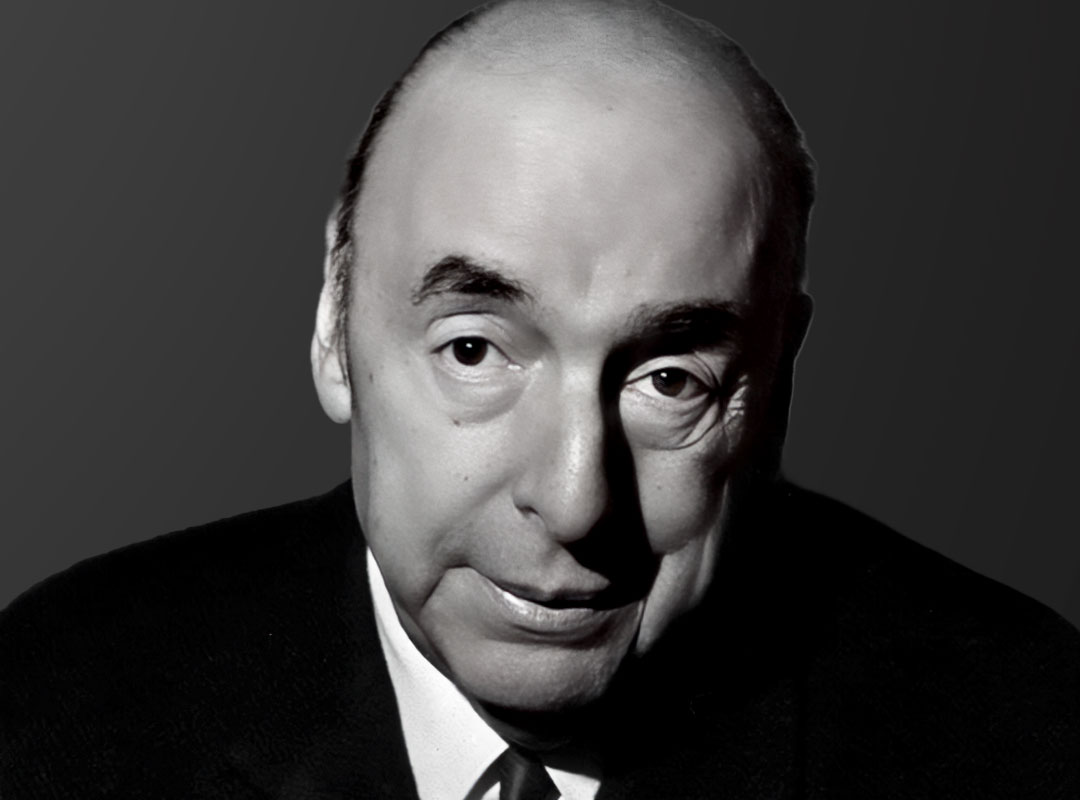
Carolyn and I have appreciated the work of Chilean poet Pablo Neruda, who was one of the most influential poets of the twentieth century and is widely regarded as Chile's national poet. He is best known for his passionate love poems—especially those in Twenty Love Poems and a Song of Despair — as well as his sweeping political and epic works, including Canto General, which celebrates the history, landscapes, and peoples of Latin America. In 1971, he was awarded the Nobel Prize in Literature for poetry that, in the words of the Nobel Committee, gave "life and destiny" to an entire continent through its powerful lyrical voice. Beyond literature, he also served as a Chilean diplomat and senator, becoming an internationally recognized cultural and political figure whose work continues to inspire readers around the world.
Although Neruda is often remembered as a political poet, I think it's worth emphasizing that what made him extraordinary was his ability to find the sublime in the ordinary. He could write with equal passion about a lover, a tomato, a pair of socks, the Pacific Ocean, or the history of an entire continent. That gift, revealing the miraculous within everyday life, is one of the reasons his work continues to resonate with so many people.
Pablo Neruda was born as Ricardo Eliécer Neftalí Reyes Basoalto in 1904, in the small Chilean town of Parral. His father was a railroad employee who worked as a conductor, and his mother was a dedicated elementary school teacher. His father valued practical work and initially discouraged his son's literary ambitions, while his mother — who died of tuberculosis when Neruda was only a few months old, and whose passing was a profound loss that would echo through his poetry — left behind a legacy of education and learning that Neruda would later cherish.
Around 1906, Neruda’s father moved the family to Temuco, a frontier town surrounded by forests, rivers, and volcanoes. There, Neruda was raised by his stepmother — whose warmth and support contrasted with his father's practical nature, nurtured his sensitive imagination, and remained a lasting source of emotional support throughout his life.
Neruda was a quiet, introspective, and deeply imaginative child who found wonder in the natural world around him. Growing up in the lush forests and rainy landscapes of Temuco, he developed a lifelong fascination with nature, collecting stones, insects, feathers, and other small treasures while spending hours observing the beauty of the outdoors. He began writing poetry at an early age, despite his father's disapproval, and showed an unusual sensitivity to language, emotion, and the hidden significance of everyday life — qualities that would become hallmarks of his poetry. His curiosity, empathy, and contemplative spirit were evident from childhood and laid the foundation for his emergence as one of the world's greatest poets.
Neruda spent his childhood and early adolescence in Temuco, where he attended school and developed a deep love of reading, writing, and the natural world. During these years, he began composing his first poems and essays, revealing an extraordinary literary talent at a young age, even as his father remained skeptical of his artistic ambitions. He also came under the encouragement of his teacher, the future Nobel Prize-winning poet Gabriela Mistral, who introduced him to the works of Russian and European authors, helping to broaden his literary horizons and strengthen his commitment to becoming a writer.
During the late 1910s and early 1920s, Neruda emerged as a promising young writer, publishing his first articles and poems in local newspapers and literary magazines. In 1920, he adopted the pen name Pablo Neruda, partly in honor of the Czech writer Jan Neruda and to avoid his father's disapproval of his literary pursuits. In 1921, he moved to Santiago to study French at the University of Chile, though his true passion remained poetry. During this period, he gained increasing recognition in Chilean literary circles, culminating in the 1923 publication of his first major poetry collection, Book of Twilights, which established him as one of Chile's most promising young poets.
As his poetic voice matured, it became increasingly clear that his greatest inspiration arose not from religious doctrine but from a profound reverence for nature, humanity, and the extraordinary beauty hidden within ordinary life.
Neruda did not adhere to a traditional religious faith, instead embracing a broadly humanistic, naturalistic, and poetic worldview. Deeply influenced by the landscapes of Chile, he often wrote as though humanity and nature were inseparable, finding the sacred not in supernatural doctrines but in the sea, forests, stones, love, memory, and the ordinary objects of daily life. His poetry reflects a profound sense of wonder, interconnectedness, and reverence for existence itself, while his political convictions expressed a belief that human beings have a moral responsibility to work toward justice, compassion, and the flourishing of all people. Rather than seeking transcendence beyond the world, Neruda celebrated the mystery, beauty, and dignity of life within it.
In 1924, Neruda achieved international fame with the publication of Twenty Love Poems and a Song of Despair, a collection whose passionate, lyrical verse made him one of the most celebrated young poets in the Spanish-speaking world. Despite this literary success, he struggled financially and accepted appointments in the Chilean diplomatic service. Beginning in 1927, he served as consul in several Asian posts — including Rangoon, Colombo, and Batavia — where the isolation and cultural dislocation he experienced profoundly influenced his poetry, leading to the darker, more introspective style later collected in Residence on Earth.
During the early 1930s, Neruda continued his diplomatic career, serving in Asia before being appointed consul in Buenos Aires, and later in Barcelona and Madrid. In Buenos Aires, Neruda met legendary Spanish poet, playwright, and theater director Federico García Lorca, and they became close friends. During the outbreak of the Spanish Civil War in 1936, García Lorca was murdered, and this profoundly transformed Neruda’s worldview, shifting his poetry from primarily personal and lyrical themes toward passionate political engagement and antifascism.
Neruda described this as one of the most transformative experiences of his life. The murder of his friend and the devastation that he witnessed in Spain profoundly altered his worldview. Before this period, his poetry was largely introspective and focused on love, solitude, and personal experience; afterward, he came to believe that poetry should also bear witness to history, suffering, and the struggle for justice. This moral and spiritual awakening inspired some of his greatest works, including Spain in Our Hearts and later Canto General, transforming him from a primarily lyrical poet into a passionate voice for humanity and social conscience.
During this period, he wrote the influential collection Spain in Our Hearts, and emerged as an internationally recognized voice for social justice and political resistance. In the late 1930s, Neruda became increasingly active in humanitarian and political causes. In 1939, when Neruda was appointed Chile's special consul for Spanish immigration in Paris, rather than limiting himself to routine diplomatic duties, he helped charter the Winnipeg, a ship that carried more than 2,000 Spanish refugees fleeing the aftermath of the Spanish Civil War to safety in Chile.
Neruda later described this humanitarian mission as one of the proudest accomplishments of his life, believing that saving lives was as meaningful as writing poetry. Many of the refugees and their descendants went on to make lasting contributions to Chilean culture, science, and public life, making the Winnipeg voyage one of the most celebrated humanitarian efforts in Chilean history.
Neruda later served as Chile's consul general in Mexico City, where he continued writing and advocating for antifascist causes. During these years, his political convictions deepened, and his poetry increasingly celebrated social justice, the dignity of ordinary people, and the shared history of Latin America.
In 1945, Neruda was elected to the Chilean Senate. After publicly denouncing President Gabriel González Videla for persecuting labor activists, a warrant was issued for his arrest in 1948, forcing him into hiding before he made a dramatic horseback escape across the Andes into exile. In 1950, Neruda completed and published his monumental epic Canto General, a sweeping poetic history of Latin America that became one of his greatest literary achievements. By 1951, Neruda had become an internationally celebrated poet and a prominent voice for social justice, anti-imperialism, and political freedom.
In 1952, Neruda returned to Chile after the political ban against him was lifted and resumed an active public and literary life. By this time, he had already experienced two marriages — first to María Antonieta Hagenaar Vogelzang and later to the artist Delia del Carril — before finding enduring love with the Chilean singer Matilde Urrutia. Living with Matilde at his beloved seaside home in Isla Negra, he entered one of the most productive periods of his career. During these years, he published several major collections — including The Captain's Verses in 1952, Elemental Odes in 1954, and Extravagaria in 1958 — in which he celebrated love, nature, everyday objects, and ordinary people with warmth, humor, and profound humanity. His international reputation continued to grow, and he became one of the most admired literary voices in the Spanish-speaking world.
During the early 1960s, Neruda enjoyed worldwide recognition as one of the leading poets of his generation while continuing to write at an extraordinary pace. He traveled extensively, gave public readings, and received numerous international literary honors, becoming an important cultural ambassador for Chile. During these years, he published several significant works, including One Hundred Love Sonnets in 1959, dedicated to his wife, and collections such as Memorial of Isla Negra, reflecting on his life, memories, and enduring bond with nature. His poetry during this period blended intimate reflection with his continuing concern for humanity, peace, and social justice.
During the late 1960s and early 1970s, Neruda reached the pinnacle of his international acclaim. In 1969, he was nominated as a candidate for the Chilean presidency but withdrew in support of Salvador Allende, helping unify the left. After Allende's election in 1970, Neruda was appointed Chile's ambassador to France, where he promoted Chilean culture and strengthened international ties. In 1971, he received the Nobel Prize in Literature, honoring a lifetime of poetic achievement, although declining health forced him to resign his diplomatic post and return to Chile in 1972. Despite his illness, he continued writing and remained a revered cultural figure during his final years.
During the final year of Neruda's life, Chile was thrown into turmoil by the military coup, which overthrew President Salvador Allende. Already gravely ill with cancer, Neruda was devastated by the violence and the death of his close friend Allende. He died in 1973, at the age of 69, just twelve days after the coup. Although the official cause of death was long reported as complications from cancer, allegations that he may have been poisoned prompted decades of investigation; to date, no conclusive scientific evidence has established that he was assassinated. His funeral became one of the first public acts of defiance against the new military dictatorship, with mourners openly honoring both the poet and the democratic ideals he had championed.
Neruda left an enduring legacy as one of the greatest and most widely read poets of the twentieth century. His work spans passionate love poetry, deeply personal reflections, and sweeping epics celebrating the history, landscapes, and peoples of Latin America, inspiring generations of readers and writers around the world. Beyond his literary achievements, he is remembered for his humanitarian efforts — most notably helping more than 2,000 Spanish Civil War refugees reach safety in Chile aboard the Winnipeg — and for using poetry as a powerful voice for justice, human dignity, and political freedom. Although his political commitments and aspects of his personal life remain subjects of debate, his extraordinary command of language, emotional depth, and ability to find beauty in both the everyday and the monumental have secured his place as one of world literature's most influential and enduring figures.
Here are some of Pablo Neruda’s most memorable quotes:
Laughter is the language of the soul.
If nothing saves us from death, at least love should save us from life.
Love is not about property, diamonds and gifts. It is about sharing your very self with the world around you.
I want to do with you what spring does with the cherry trees.
He who does not travel, who does not read, who does not listen to music, who does not find grace in himself, she who does not find grace in herself, dies slowly.
To feel the love of people whom we love is a fire that feeds our life.
Every day you play with the light of the universe.
In one kiss, you'll know all I haven't said.
What did the earth teach the trees? How to speak to the sky.
There is no insurmountable solitude. All paths lead to the same goal: to convey to others what we are. And we must pass through solitude and difficulty, isolation and silence in order to reach forth to the enchanted place where we can dance our clumsy dance and sing our sorrowful song — but in this dance or in this song there are fulfilled the most ancient rites of our conscience in the awareness of being human and of believing in a common destiny.
We must dream our way.