
Rupert Sheldrake Interview
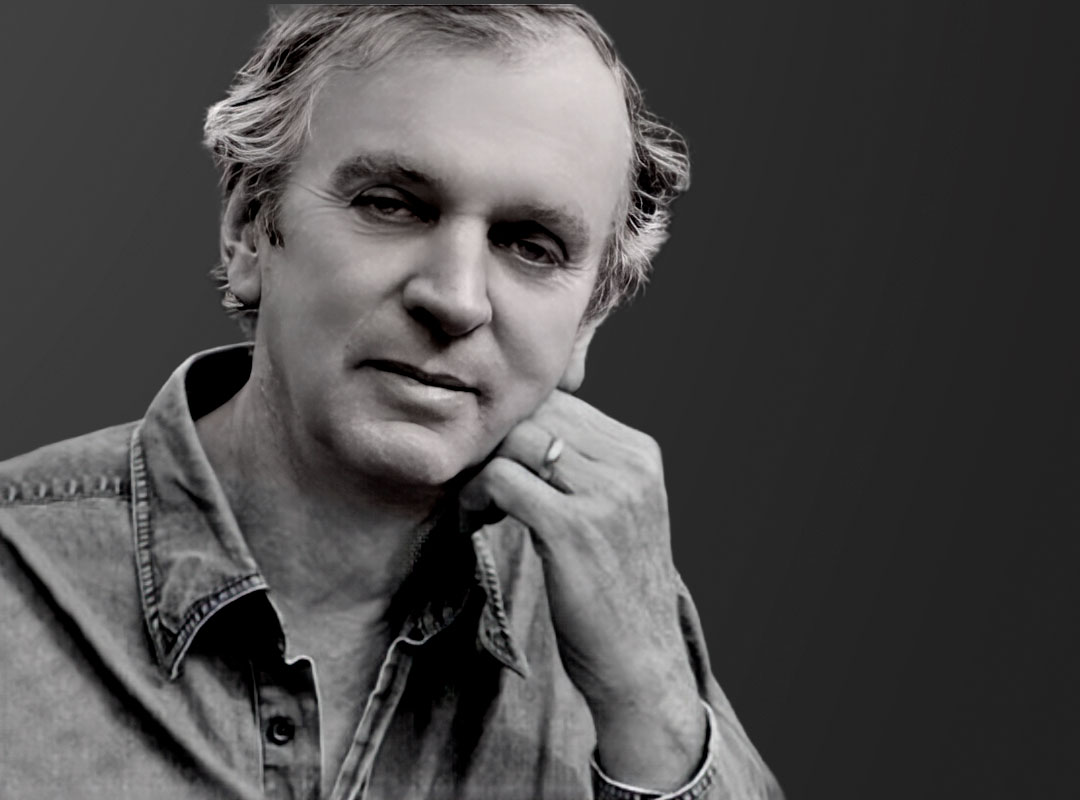
Carolyn and I have both admired and been influenced by the exciting work of British biologist Rupert Sheldrake, who we met through our beloved friend Nina Graboi in the early 1990s.
Rupert has helped to revolutionize numerous scientific fields, and his work has touched many people’s lives. He is the author of 9 bestselling books, more than 100 scientific papers, and his research is some of the most cited scientific research in the world.
Rupert was born in 1942 in Nottinghamshire, England. His parents owned a wallpaper shop, and his father was a pharmacist, who also ran a chemist’s shop. Rupert said that his father encouraged his early interest in animals and plants. He studied biology and biochemistry at Clare College in Cambridge, philosophy and history of science at Harvard, and Rupert earned a Ph.D. in biochemistry at Cambridge for his work in plant development and plant hormones.
Rupert is best known for developing the theory of formative causation, which hypothesizes the existence of “morphic fields,” or non-material regions of influence, like the other types of fields in physics, that guide the development of organic and inorganic forms, as well as psychological and social structures, through a resonance with forms from the past. Many people are familiar with a variation of this idea through the popularization of the concept of the “100th monkey,” which implies a transpersonal form of learning.
This theory, first expressed in Rupert’s 1981 book A New Science of Life, is at the heart of much of his research, and it helps to explain a number of persistent mysteries in science,— like how the genetic information in our cells is translated into our 3-dimesional biological forms, or how homing pigeons navigate themselves.
According to Rupert’s theory, “morphogenetic fields” are one type of morphic field, a biological field, and this concept has been incorporated into a number of Carolyn’s paintings, some of which are included below.
Since 1981 Rupert has developed this theory and applied it to numerous scientific fields. His 1995 book The Presence of the Past lays out evidence for the theory of formative causation, and it explores the implications of morphic fields for biology, physics, psychology, and sociology.
One of the wonderful things about Rupert’s work is that he has developed a number of simple experiments that anyone can do at home, which produce results that challenge conventional scientific understanding, and he has helped to start a grassroots global science movement. In his book Seven Experiments that Could Change the World he outlines easy-to-do experiments — such as testing our sense of being stared at, or studying how termite hill organization is unaffected by physical barriers,— that conventional science has great difficulty explaining.
For several decades Rupert has also been studying the unexplained powers of animals, such as dogs (and other pets) that seem to know when their owners are coming home through a form of telepathy. Rupert views telepathy, and the sense of being stared at, as natural biological traits that evolved through natural selection, and are retained due to their survival value.
Rupert studies those areas that conventional science ignores, and asks radical questions that challenge the foundations of science. Do the fundamental constants of nature, like the speed of light or the gravitational constant, remain the same or do they evolve over time? Are phantom limb experiences indicative of somatic fields? Does telepathy play a role in the anticipation of phone calls? Could the sun and other stars be sentient beings?
Rupert’s wonderful book The Science Delusion (the title of which is a response to Richard Dawkins’ book The God Delusion) shows how science is being constricted by assumptions that have hardened into dogmas and would be better off without them. Rupert has strong spiritual beliefs, and has been profoundly influenced by the Christian and Hindu faiths. He once told me that a morphic field was a “soul,” and much of his work seeks to integrate science with spirituality. His most recent books explore the mystery of consciousness and the potential of spiritual experiences, such as Ways to Go Beyond and Science and Spiritual Practices.
I worked closely with Rupert from 1995 to 1999, and I spent a month in London with him and his family. I did the California-based research for two of his books, Dogs That Know When Their Owners are Coming Home and The Sense of Being Stared At. We coauthored 3 scientific papers together and I interviewed him for two of my previous books, Mavericks of the Mind (which also includes my interview with Carolyn) and Conversations on the Edge of the Apocalypse. I interviewed Rupert again recently for my new book just a few weeks ago. Here is an excerpt from our conversation:
David: What do you personally think happens to consciousness after physical death and the deterioration of the brain?
Rupert: ...what I think... is that our conscious existence after physical death is rather like dreaming. We can go on dreaming after we're dead but we can't wake up anymore, because the physical body is no longer there to wake up in. So, I think that the survival of physical death is likely to be in a kind of dream realm, and that dream realm, as I said earlier, is continuous with the realm experienced under psychedelics, and it also may be shared between different people and even with animal species.
We may have shared dreams; the dream realm may not just be our individual dream realm but a collective human dream world, and even one that includes all sorts of species, and possibly dreaming organisms on other planets or in other star systems. So the dream world, which we inhabit after death, depends on our memories, our desires and our beliefs. If you believe that there's absolutely nothing after death, that it will just go extinct, your mind will just go blank. That may be what happens.
If, even if you're in disturbing dreams, you believe that after death there are beings that can help and save you— like Christ or the saints— then that may well be what happens. If you believe that no one can save you, no one can help you, you're just trapped in your own world, your own mind, then you may end up in a kind of nightmare scenario of isolation and being trapped with recurrent obsessions and fears, which may be rather like hell. It would be rather like an ongoing nightmare.
So I think the kinds of dreams we have, and the kind of dream world we inhabit, depends very much on who we are, what we've done, what we expect, what our experience is, and what our faith is, because I think that our religious faith or lack of it will play a major role in our life after death. This is because, in a sense, it's all in the mind, and therefore what's in our minds really matters. ...
...I'm a Christian. I believe that the ultimate conscious reality is God, and that the divine consciousness precedes the appearance of the universe and underlies nature. My view is the standard view, the traditional view. It's not that God is like an external engineer, or a mechanic who designs the universe like a machine and presses the start button and then lets it run automatically. Rather, the entire universe is within the being of God, sustained from moment to moment by God and the divine consciousness. So all forms of consciousness within the universe, including human and animal consciousness, are derived from a greater mind of which these minds are a part.