Rolling Stone Takes a Look at the Evolving Relationship Between Artists and Cultural Institutions through Carolyn Campagna Kleefeld’s Work

Rolling Stone Takes a Look at the Evolving Relationship Between Artists and Cultural Institutions through Carolyn Campagna Kleefeld’s Work

A Look at The Evolving Relationship Between Artists and Cultural Institutions through Carolyn Campagna Kleefeld’s Work

In Partnership with Talha Munir by ALEX FORD

When you walk through the doors of the Carolyn Campagna Kleefeld Contemporary Art Museum at California State University, Long Beach, you’re stepping into a space that reflects one of the most meaningful shifts in the contemporary art world: the emergence of the artist-patron.

Carolyn Campagna Kleefeld isn’t simply a philanthropist who wrote a check nor just an artist whose work hangs on gallery walls.

She is both, and just as her work often blends literary and visual elements to create a new form of artistic interpretation, Kleefeld has helped redefine what the relationship between artists and cultural institutions can look like.

A New Kind of Cultural Actor

Historically, the relationship between wealthy patrons and art institutions followed a familiar pattern where a collector or benefactor provided financial support, and in return the institution bore their name or displayed work from their collection. The patron and the artist were almost always different people.

Kleefeld represents something newer and more dynamic. As donor, artist and subject, she has redefined those traditional distinctions into a single, stronger and more dynamic relationship with the institutions she supports.

This kind of triple role was on full display when Kleefeld made the largest donation in California State University, Long Beach’s history in 2019 in the form of a $10 million gift as part of a $24 million fundraising campaign toward the expansion of what was then called the University Art Museum. She went beyond simple financial commitments in a much more personal expression of her support by also donating more than 120 of her own artworks, her personal archives, her library and more than 20 books she had authored to the museum’s permanent collection.

When the museum reopened in February 2022 after a full renovation, it housed 178 of her drawings and paintings as part of its holdings, which is a body of work that enriches the institution academically and visually while reflecting her sustained artistic vision.

Kleefeld’s donation also enabled the museum to expand its storage space and, in turn, its own collection. Most importantly, the museum was able to maintain the Hampton Collection, which would have been lost without the added storage.

What you see in that arrangement isn’t just generosity but intentionality. Kleefeld didn’t separate her financial giving from her artistic identity. She brought them together, signaling that an artist’s relationship with an institution can be just as creative and personal as the work itself.

How Artist-Institution Relationships Have Evolved

To appreciate what Kleefeld represents, it helps to understand how museum funding and artist relationships have changed over the past two decades.

Naming rights, which were long reserved for major wings or entire buildings, have become a central tool for institutions seeking to grow their capacity and expand their programming. Museums across the country now rely increasingly on transformational private gifts to fund everything from construction to endowments.

What has emerged alongside that trend is a new category of donor: the artist-philanthropist.

These are people whose giving is inseparable from their creative legacy. Rather than simply funding institutions that display other people’s work, they invest in spaces that can also contextualize and preserve their own. The result is a more layered relationship between benefactor and institution where the donor’s artistic vision is part of the gift itself.

The American Alliance of Museums’ Code of Ethics calls on institutions to “take steps to maintain their integrity so as to warrant public confidence.” For museums, welcoming artist-philanthropists like Kleefeld is one way to meet that standard. Her gifts have expanded infrastructure, deepened collections and broadened access, all without cost to the communities these institutions serve.

An Artist Whose Work Earns Its Place

Central to understanding Kleefeld’s relationship with institutions is understanding the depth of her artistic career. Born in South London and raised in California, she studied art and psychology at UCLA and went on to develop a body of work spanning romantic figurative painting and bold abstract expression. She has also authored 25 books, which have been translated into more than 10 languages and are distributed internationally. Acclaimed titles include The Alchemy of Possibility: Reinventing Your Personal Mythology and Soul Seeds: Revelations and Drawings, making her one of the rare cultural figures who works fluidly across both visual and literary forms.

Her work has been exhibited at institutions well beyond those she has funded. The Frederick R. Weisman Museum of Art at Pepperdine University presented a full retrospective of her paintings and drawings in 2008, accompanied by an exhibition catalog titled Carolyn Mary Kleefeld: Visions from Big Sur with commentary by curator Michael Zakian. The California State University, Long Beach Museum describes her work as “intuitive, symbolic expressionism relative to her lived experience.”

That established artistic identity matters in the context of artist-institution relationships. It means that Kleefeld’s 178 pieces now held in the California State University, Long Beach Museum’s permanent collection of over 2,000 objects sit alongside celebrated modern and contemporary artists as the work of a serious practitioner with decades of exhibition history behind her. Her dual role as donor and artist strengthens rather than complicates the institution’s collection.

Expanding the Model: A New Arts Center in Massachusetts

Kleefeld’s main philanthropic intent is to inspire students through her art. A plaque displayed in the Contemporary Art Museum at California State University, Long Beach bearing her name reflects this sentiment perfectly and reads, “My life’s passion has been to create art from an unconditioned well of being and to inspire such a journey in others. To have my art and writing available permanently in this educational setting is a dream realized. My aspiration is that both students and visitors to the university will embark on their own journeys of inner discovery and creative expression. . . May the Carolyn Campagna Kleefeld Contemporary Art Museum at California State University, Long Beach be a source of inspiration for future generations of students and visitors to recognize the profound impact creativity can have on all our lives.”

Kleefeld has carried this model of engaged artistic philanthropy beyond California. She is currently funding the Campagna Kleefeld Center for Creativity in the Arts at Massachusetts College of Liberal Arts (MCLA), supporting the construction and initial operation of a state-of-the-art arts and teaching center that will serve as the college’s primary gallery and programming hub.

The space is designed to function as a public venue and a hands-on learning environment for students. MCLA President James F. Birge, Ph.D., said of the gift: “Carolyn Kleefeld’s extraordinary generosity will allow MCLA to build and steward a cutting-edge facility that will exponentially enhance the quality of our teaching, expose all our students to new and exciting forms of art, and serve the broader community in immeasurable ways. Carolyn’s forward-thinking gift is a game-changer, not only for our students and faculty but also Berkshire County and its surrounding communities, and will continue to be for generations to come.”

When you look at this second major institutional investment, you see the same philosophy at work: Kleefeld’s approach represents true cultural leadership by example. She isn’t simply donating money. She’s helping to shape the environments in which future artists will learn, create and encounter art. That is the hallmark of an artist who thinks institutionally and someone whose relationship with cultural spaces goes beyond transactional giving into something more like stewardship.

What Kleefeld’s Story Tells Us About the Future

As you consider the future of artist-institution relationships, Kleefeld’s engagement with California State University, Long Beach and MCLA offers an instructive example.

Museums and cultural centers increasingly depend on major gifts to survive and expand. University President Jane Conoley praised, “Carolyn’s impact on California art has been nothing short of remarkable and we are delighted that the University Art Museum will be part of her lasting legacy, as well as provide us with the opportunity to showcase her work and that of other significant artists.”

University spokesperson Gregory Woods noted that “these gifts are essential in expanding educational opportunities available for our students and provide cultural enrichment for our community,” while

When the donor is also a practicing artist, that relationship can produce something richer than funding alone. Her endowment at California State University, Long Beach funds annual scholarships for College of the Arts students, supports an interdisciplinary lecture series, finances a student intern position and provides ongoing museum programming enhancements. The 11,000-square-foot museum complex is always free to the public.

At MCLA, an entirely new building is rising that will serve students and the surrounding community for generations. These are the fruits of a relationship between an artist and the institutions she believes in and one built on creative conviction as much as financial generosity.

What you’re witnessing through Carolyn Campagna Kleefeld’s work isn’t simply the story of one artist and two museums.

It’s a case study in how the relationship between artists and cultural institutions is evolving toward something more personal, more integrated and more enduring. As philanthropic giving continues to shape the cultural landscape, Kleefeld’s model shows that the most meaningful partnerships are those where the artist and the institution grow together.


Share Story:
Campagna Kleefeld Center for Creativity in the Arts to be Established at Massachusetts College of Liberal Arts in North Adams, MA

Campagna Kleefeld Center for Creativity in the Arts to be Established at Massachusetts College of Liberal Arts in North Adams, MA

Campagna Kleefeld Center for Creativity in the Arts

Illustration is an Artist's Conception

As related in the press release from Massachusetts College of Liberal Arts, The Campagna Kleefeld Center for Creativity in the Arts will create a space for the exploration of creativity, enhancing all students’ experiences on campus, linking the arts with academic disciplines, from humanities and social, biological, and physical sciences to business and computer science — and serve as an essential part of the MCLA learning experience. James Birge, president of MCLA says, “Carolyn’s real gift to MCLA is the inspiration to be creative, to have a space where we can be challenged to define what art is and how creativity is a form of expression of who we are, and how we value one another.

As the new primary gallery and arts programming space on campus, The Campagna Kleefeld Center for Creativity in the Arts will support MCLA programs by providing opportunities for students to engage with artists, their work, and the community. It will serve as a dynamic and flexible space for faculty engagement and curricular innovation, fostering meaningful interactions with a rotating array of exhibits and programs. This new venue will also support MCLA’s Benedetti Teaching Artists-in-Residence, student artists-in-residence, and student artists.

A cornerstone of The Campagna Kleefeld Center for Creativity in the Arts will be its integration of Carolyn Kleefeld’s visual art, writing, and poetry, offering ongoing opportunities for students to curate and engage with her work. Carolyn is the author of twenty-five books, many of which are bilingual and trilingual translations, distributed worldwide. Student engagement with Carolyn's work may take many forms, including independent and collaborative projects that examine a current exhibit, internships that focus on situating Carolyn's work both in The Campagna Kleefeld Center for Creativity in the Arts but also in secure areas across campus, and coursework that engages Carolyn's visual art, writing and poetry in a wide range of contexts, especially in terms of demonstrating and celebrating the creative process.

A compelling aspect at MCLA, is its location in an art mecca. MASS MoCA (The Massachusetts Museum of Contemporary Art) is also in North Adams, and the Clark Institute and Williams College, with its large art museums, are nearby and all these art institutions collaborate and share programs.

As also stated by President Birge, “Carolyn’s forward-thinking gift is a game-changer, not only for our students and faculty but also Berkshire County and its surrounding communities and will continue to be for generations to come.

About MCLA

At MCLA, we’re here for all — and focused on each — of our students. Classes are taught by educators who care deeply about teaching, and about seeing their students thrive on every level of their lives. In every way possible, the experience at MCLA is designed to elevate our students as individuals, leaders, and communicators, fully empowered to make their impressions on the world. In addition to our 130-year commitment to public education, we have fortified our dedication to equitable academic excellence. MCLA has appeared on U.S. News & World Report’s list of Top Ten Public Colleges for 10 consecutive years, earning the No. 6 spot on the list of Top Public Liberal Arts Schools in the nation for 2025, after earning the No. 7 spot the prior three years. The College’s focus on affordable education and economic prosperity is reflected in additional 2025 U.S. News Rankings: No. 5 for Top Performer on Social Mobility for liberal arts colleges in the state and No. 2 for Top Performer on Social Mobility for public liberal arts colleges in the country.

Share Story:
A Groundbreaking Arts Center at MCLA

A Groundbreaking Arts Center at MCLA

Construction of the New Campagna Kleefeld Center for Creativity in the Arts at MCLA is Right Around the Corner

Excerpted from Berkshire Magazine – Fall 2025
by Elise Linscott Gladstone

Soon, MCLA will have a new state-of-the-­art building welcoming visitors to its campus, deepening its connection to the surrounding arts institutions and strengthening its presen­tation of art in North Adams.

The new Campagna Kleefeld Center for Creativity in the Arts, with construction to begin this fall and an anticipated opening in 2027, will be the first building of its kind for MCLA, making it a natural fit and an expansion for a liberal arts college surrounded by the culturally rich, arts-focused Berk­shires community, says MCLA President James Birge. It will also allow the college to deepen partnerships with places like MASS MoCA, the Clark Art Institute, and the Williams College Museum of Art (with a new building projected to reopen in 2027), in terms of job placements and reciprocal programming.

Having this facility allows us to think anew about what those partnerships are like,” says Birge. There will be new opportunities for partner­ship and shared programming, he says. For in­stance, students will gain hands-on experience in museum and gallery operations, communi­ty education, and artist collaboration. This positions us to be the institution in New England for arts management,” Birge says. These partnerships will help grow enrollment and create more opportunities for better teaching and learning, while also allowing us to think about new majors that could emerge from these collaborations.” He did not specify what those majors could be, but says that the interdisciplinary nature of the center means we're exploring how it can enhance programs across multiple disciplines, as well as in the graduate and continuing education space.” There are limitations of MCLA Gallery 51's current location on Main Street in North Adams, including the space avail­able. The new facility, he explained, will allow for more ambitious programming, including public exhibitions of visiting artists and interactive sessions where audiences can engage with the creative process, from the formation of ideas to curation to installation. Located at the corner of Porter and Church streets, the Campagna Kleefeld Center for Creativity in the Arts will be the first building that visitors and students see as they enter the campus from North Adams. The new center was made possible by a gift of an undisclosed amount from Cali­fornia-based visual artist, poet, and author Carolyn Kleefeld. A cornerstone will be its integration of Kleefeld's art and poetry, offering ongoing opportunities for students to curate and engage with her work as a model for exploring the creative process. This engagement will extend to other art• ists, with students actively participating in selecting, situating, and appreciating works in the gallery.

Kleefeld says she hopes it will be a creative, explorative interaction, inspiring expansive expression in myriad mediums, conversations, living life.”

Share Story:
Massachusetts College of Liberal Arts Announces Plans for Campagna Kleefeld Center for Creativity in the Arts

Massachusetts College of Liberal Arts Announces Plans for Campagna Kleefeld Center for Creativity in the Arts

Campagna Kleefeld Center for Creativity in the Arts

Illustration is an Artist's Conception

As related in the press release from Massachusetts College of Liberal Arts (MCLA), The Campagna Kleefeld Center for Creativity in the Arts will create a space for the exploration of creativity, enhancing all students’ experiences on campus, linking the arts with academic disciplines, from humanities and social, biological, and physical sciences to business and computer science — and serve as an essential part of the MCLA learning experience. James Birge, president of MCLA says, “Carolyn’s real gift to MCLA is the inspiration to be creative, to have a space where we can be challenged to define what art is and how creativity is a form of expression of who we are, and how we value one another.”

As the new primary gallery and arts programming space on campus, The Campagna Kleefeld Center for Creativity in the Arts will support MCLA programs by providing opportunities for students to engage with artists, their work, and the community. It will serve as a dynamic and flexible space for faculty engagement and curricular innovation, fostering meaningful interactions with a rotating array of exhibits and programs. This new venue will also support MCLA’s Benedetti Teaching Artists-in-Residence, student artists-in-residence, and student artists.

A cornerstone of The Campagna Kleefeld Center for Creativity in the Arts will be its integration of Carolyn Kleefeld’s visual art, writing, and poetry, offering ongoing opportunities for students to curate and engage with her work. Carolyn is the author of twenty-five books, many bilingual and trilingual translations, distributed worldwide. Student engagement with Carolyn's work may take many forms, including independent and collaborative projects that examine a current exhibit, internships that focus on situating Carolyn's work both in The Campagna Kleefeld Center for Creativity in the Arts and in secure areas across campus, and coursework that engages Carolyn's visual art, writing, and poetry in a wide range of contexts, especially in terms of demonstrating and celebrating the creative process.

A compelling aspect of MCLA is its location in an art mecca. The Massachusetts Museum of Contemporary Art (MASS MoCA) is also in North Adams, and the Clark Institute and Williams College, with its large art museum, are nearby and all these art institutions collaborate and share programs.

Carolyn’s forward-thinking gift is a game-changer, not only for our students and faculty but also for Berkshire County and its surrounding communities, and will continue to be for generations to come. — MCLA President James F. Birge, Ph.D.

About MCLA
At MCLA, we’re here for all — and focused on each — of our students. Classes are taught by educators who care deeply about teaching, and about seeing their students thrive on every level of their lives. In every way possible, the experience at MCLA is designed to elevate our students as individuals, leaders, and communicators, fully empowered to make their impressions on the world. In addition to our 130-year commitment to public education, we have fortified our dedication to equitable academic excellence. MCLA has appeared on U.S. News & World Report’s list of Top Ten Public Colleges for 10 consecutive years, earning the No. 6 spot on the list of Top Public Liberal Arts Schools in the nation for 2025, after earning the No. 7 spot the prior three years. The College’s focus on affordable education and economic prosperity is reflected in additional 2025 U.S. News rankings: No. 5 for Top Performer on Social Mobility for liberal arts colleges in the state and No. 2 for Top Performer on Social Mobility for public liberal arts colleges in the country.

Share Story:
The Carmel Pine Cone – Her Inner and Outer Worlds Collide in Big, Colorful Bursts

The Carmel Pine Cone – Her Inner and Outer Worlds Collide in Big, Colorful Bursts

Carolyn Mary Kleefeld – The Carmel Pine Cone

Article and Photo by DENNIS TAYLOR

Her Inner and Outer Worlds Collide in Big, Colorful Bursts

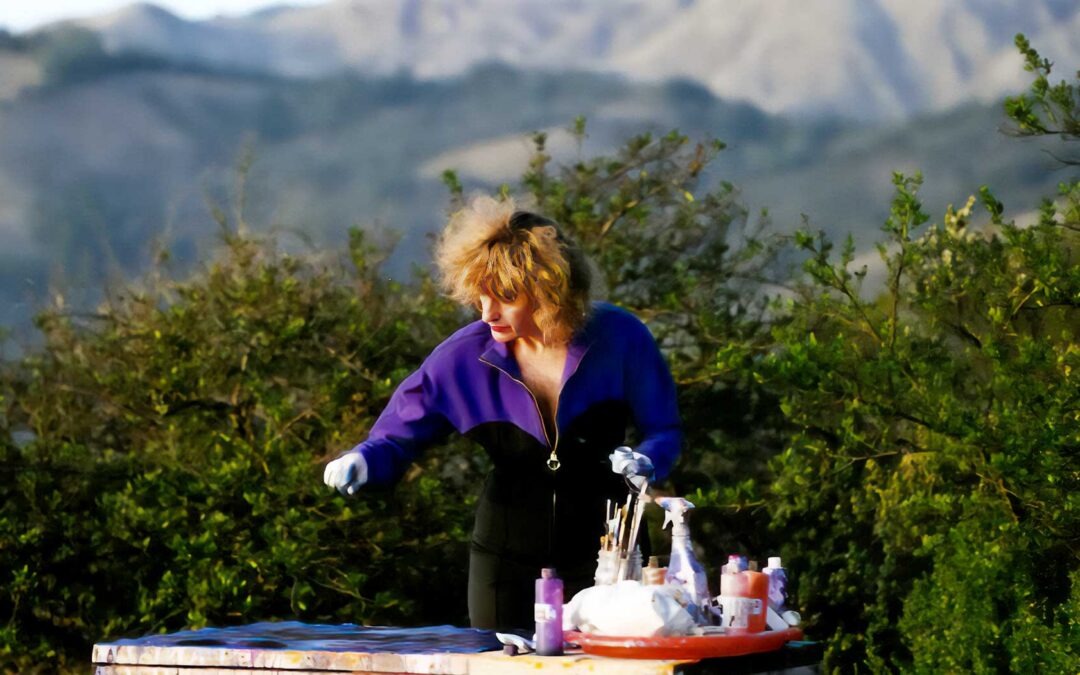
THE LADY on the mountaintop is a philosopher, a spiritual seeker, a dancer, an artist, an author, and a poet. Carolyn Mary Kleefeld could be the muse for a romantic poet, herself.

Her home, deep in the Big Sur forest, is only steps from a majestic cliff that towers over Pfeiffer Point, with a panoramic view that hardly seems real.

The interior of her house is dark and silent, the epitome of solitude, but every wall is adorned with enormous explosions of color — works of acrylic, ink, gouache and mixed media on canvas or board. Some are 5-by-6 feet. Many were painted in minutes.

“I’m a Taoist, so I love to do things really fast, without thinking about it — no conceptualizing … just being drawn to color,” said Kleefeld, who also has done romantic, figurative work. "I did one yesterday in three minutes ... well, maybe five ..and it's just perfect. I do very well when it's spontaneous.… and it’s just perfect. I do very well when it’s spontaneous.

Six Pushcart Prize Nominations

“Most of what I’ve done in my life has been instinctive and intuitive,” said Kleefeld, who has authored 25 books of poetry and prose — writings that have been translated into Korean, Romanian, Japanese, Italian, Sicilian, Chinese, Arabic, Bengali, Greek, Persian and Bulgarian. Some became texts in university classrooms. Between 2008 and 2014, she was nominated six times for the Pushcart Prize, which honors "the best in poetry, short fiction, essays, or literary whatnot."

Her first book, "Climates of the Mind," published in 1979, was a bestseller (rare for poetry) that was translated into Braille by the Library of Congress.

Another bestseller, "The Divine Kiss: An Exhibit of Paintings and Poems" (2014), was inspired by David Campagna, the love of her life, whom she married on Valentine's Day 2017. He died 20 days after their wedding, ending his three-year battle with esophageal cancer.

"Marrying David was absolutely the high point of my life, even though we knew he was going to die," she said of Campagna, who had worked as a Hollywood actor, and also a frequent stand-in and stuntman for Christopher Walken. "We had something so rare, so perfect, and the way he dealt with his illness was one of the most heroic and magnificent gestures imaginable."

Yet another Kleefeld bestseller, "Immortal Seeds: Bearing Gold From the Abyss," was published in 2022, but also was written during the final two years of Campagna's life, during which she commuted weekly from her Big Sur home to live with him in an L.A. hotel while he was enduring chemotherapy.

"David had a hilarious sense of humor and constantly used it to cheer up everyone around him when he was getting those treatments. He dragged himself across the room one day, strapped to all of those chemicals, to meet Leonard Cohen and give him a copy of 'The Divine Kiss," Kleefeld said of the celebrated singer-song-writer who died of leukemia in November 2016. "Leonard took the book with him, and later he said, 'I hope you know how she feels about you and that you inspired this book.'"

Escaping the Nazis

Kleefeld was born in Catford, South London, England, the youngest daughter of Amelia and Mark Taper, who helped smuggle hundreds of Catholic and Jewish children out of Nazi Germany during World War II, then brought their family to America.

Her mother did freelance illustrations for Vogue and her father was a real estate investor, builder, and philanthropist in Southern California.

Kleefeld wrote and illustrated her first book at age 9 after observing a cluster of dust particles dancing in a ray of sunlight coming through her bedroom window.

"I created another universe, with an imaginary family, then drew pictures of all the characters," she remembered of the book she called "The Nanose."

"That book turned out to be psychologically revealing," said Kleefeld, who would study psychology at UCLA. "It showed the disconnection I had with my own family - that my dad wasn't really there for us on a psychological or emotional level."

At age 5, she already was taking ballet at Santa Monica's Toland School of Dance when a visiting instructor from the Bolshoi Ballet tried to convince her mother to send Carolyn, her youngest child, to its elite academy in Russia. "I was the youngest of three children in our family, and, of course, there was no way she was going to allow me to go to Russia by myself," Kleefeld said.

By the time she was 13, she was enamored with French writer Guy de Maupassant and began writing short stories of her own. At 15, her well-to-do family moved to Beverly Hills, where Carolyn never felt comfortable, but found success as a model and explored acting.

A Hollywood husband

Her first husband, Travis Kleefeld - known professionally as Tony Travis - was an actor whose credits included roles in "77 Sunset Strip" and "Perry Mason," among others, along with a feature film called "The Beat-niks." He was a talented singer, discovered by Dinah Shore, who helped him cut several albums.

Their marriage produced two daughters, Carla and Claudia, but ended after 9 1/2 years, and Carolyn Kleefeld moved to Malibu, where she thrived in a meditative environment among a creative community of free thinkers. That's where she began writing "Climates of the Mind."

Shortly after completing the book, she made a visit to Esalen Institute, took a workshop on "rebirth," and fell in love with Big Sur.

"That was in 1980, around Christmastime, and I liked it so much that I decided I had to stay for a while," she said. "And I never left."

Over the years, Kleefeld's circle of friends has included Timothy Leary, who spent time at her house, Rod Steiger (whom she dated in Malibu), Hollywood producer Darryl F. Zanuck ("The Longest Day," "The Grapes of Wrath," and many others), self-help guru Wayne Dyer, poet Allen Ginsberg, psychoanalyst John Lilly and musician/author/ psychotherapist/lecturer Laura Huxley. "Laura was my best friend," she said of Huxley, who died in 2007.

"I've known a lot of interesting people," she said. "I never sought them out - it just happened."

Since moving to her mountaintop more than four decades ago, creating art has been Kleefeld's primary focus and passion. Her $10 million endowment resulted in the expansion and renaming of the Carolyn Compagna Kleefeld Contemporary Art Museum at California State University Long Beach.

Living in paradise - and in isolation - can often be a lonely and difficult lifestyle, she said. "It's like a monastery up here, and a very odd life, she said. "I sometimes feel like a sort of priestess, venturing into the wilderness of the unconscious, constantly discovering things that add to my understanding of life. And that's what keeps me alive, centered and integrated.

"Making art, for me, is like a transcendent experience," said Kleefeld. "It's like a special dimension - another place I can go - and it's the best place."

Share Story:
Monterey County Herald Tribute to Carolyn

Monterey County Herald Tribute to Carolyn

Carolyn Mary Kleefeld – Monterey Herald

By LISA CRAWFORD WATSON

Author and artist Carolyn Mary Kleefeld awakens in her Big Sur home, breathes in the rarified air of an utterly wild place that refuses to be tamed, and wanders down to the big stone pool for a cool swim. She feels the freshwater against her skin, breathes in clear air, and notices a hawk on the wing. Soon, she will be ready to read, to write, to paint.

Kleefeld is a spirit unfettered, who breathes with the rhythms of the Big Sur landscape but who also feels a certain vitality in traveling, in creating a world context for her creative expression. COVID curtailed that, but once she could continue to travel, she did, with her beloved David Campagna, a man she describes as Italian, Portuguese, a Mediterranean lover, a wise and humble partner, and the great love of her life.

He took her back to England, to the place where she was born, to a mountain top in Greece, and other places of meaning for her all over the world, as they had, so many times before.

And then he died.

Kleefeld has written and published 25 books over the years, 15 of which, she said, have been translated into many languages. All of them are an exploration of the artistry and metaphysics of life and love, particularly her most recent book, “Immortal Seeds: Bearing Gold from the Abyss,” published in 2022, in tribute to Campagna.

“Immortal Seeds” is the story of my love for and expressed with David,” said Kleefeld, “told through poetry and paintings, particularly the last three and a half years, as he waged his own brand of warfare against the C word.”

The day Campagna learned in 2014 that he had what Kleefeld will call only “The C Word,” his response was to take her to a place in downtown Lost Angeles that breeds butterflies.

“He escorted me into a contained area where the butterflies were flying all about,” she said. “What a way to react to a terminal diagnosis. What a context in which to introduce The C Word to your beloved. His courage lifted him above fear to a place of concern for me.”

It was in this mindset that Kleefeld framed her own thoughts and feelings about a diagnosis that would end something in her life, as well as his, into poetic expression.

And so, she wrote, “I called to the greater will to transform my mind as I felt crushed against the rock of fear. Terrified I could lose my beloved… I don’t want to die with a broken heart. Our life is too infinite to be that mortal. I don’t want to let my beloved down. I want to be as strong as he… I want to dance with him until the end of time, until our next beginning.”

Much more than her mourning, Kleefeld’s book, a pairing of her painting and her poetry, a harkening to the likes of painter Marc Chagall and poet Barbara Mossberg, is a vivid portrayal of love and loss, an honesty of imagery and expression that reaches beyond courage to truth.

Carolyn Mary Kleefeld | Author: Immortal SeedsThe book begins, as the relationship did, with exuberant gratitude and joy.

“I couldn’t be happier,” she wrote. “I’m dancing on the moonbeams of passion. Never have I known such a romantic creature and so much fun and humor. I’ve been graced by the gods to have these wondrous times with him. May it last as long as we wish it to.”

It didn’t last, not in the form in which the couple were enjoying their life together, as Campagna passed away in 2017, inviting Kleefeld, as he departed, to “be the butterfly of us.” And yet, for Kleefeld, their relationship continues. When the joy of rapture was met with the sorrow of loss, she buoyed herself by understanding that both what was and what would be were vital and true, and everlasting.

“I ended the book,” she said, “understanding our relationship as a never-ending story. The love goes on. My last poem is ‘My Eternal Husband’.”

“I lay there like a rag,” she wrote “and then I thought of you, my beloved, and how you would call me Babycakes and how your kiss always transformed me, and suddenly you appeared, enveloping me with a kiss and love… Yes, you have come back from that other world to embrace me and give me that kiss on the forehead… My eternal husband.”

The essence of a Spiritual Artist
Born in Catford, England to her mother, an artist for Vogue, Kleefeld wrote and illustrated her first book when she was 9 years old. Creative expression is in her blood, said. When asked her age, she was quick to confirm that the only thing she’ll reveal is that she celebrates every year on May 11, always with a great cake. Otherwise, she said, “I’m ageless, timeless, like life.”

Kleefeld actually grew up in Southern California, where she studied art and psychology at UCLA. By 1980, she had moved to her cliff-dwelling retreat in Big Sur, where creativity pulses through her like a life force, inspiring poetry and paintings, drawings and books, and an uplifting way of moving through her life on earth — and above and beyond.

“Carolyn understands the entire world as a great metaphysical structure involving the essential mysteries of time, space, matter, and fate. She paints to reveal these eternally mysterious truths. By capturing these universal wonders in a work of art, she invites us to grasp the essential paradox of life,” wrote the late Michael Zakian, Ph.D., in ‘Visions from Big Sur.’ “That is the great gift of her art.”

“Immortal Seeds: Bearing Gold from the Abyss,” is available at the Henry Miller Library, at the Phoenix Shop in Big Sur, and at River House Books in The Crossroads Carmel, as well as Luminata Books & Gifts in Monterey, among many of Kleefeld’s other works, as well as on Amazon.

Share Story:
Loading...